
A pedal kayak changes bass fishing in one specific way. Your hands stay on the rod while your legs hold the boat on a spot, back you out from under a fallen tree, or push you across a flat. A paddle kayak can do all of that too, but every move costs you a hand off the rod.
The downsides are heavier weight, higher cost, and extra parts to maintain. Every boat below weighs more than its paddle equivalent, costs at least four figures, and needs a cart or a trailer. Our pick if you buy one boat: the Old Town Sportsman PDL 120, at around $2,500 to $3,000. The Hobie Mirage Outback is the fin-drive answer for weeds and shallow water, the Old Town BigWater PDL 132 is the fast big-water step up, the Seastream Angler 120 PD gets you pedaling for roughly half the price of the big names, and the Native Slayer Propel 10 LTE is the one you can load alone.
Old Town Sportsman PDL 120 ~$2,500–3,000
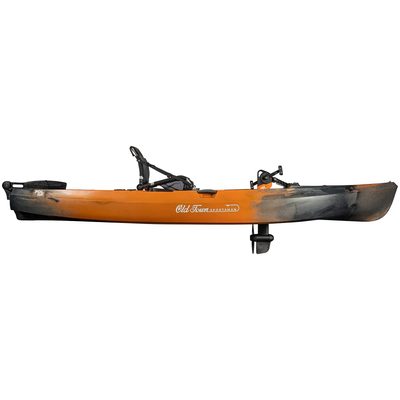
The PDL 120 takes our top pick for a simple reason. Owners keep describing the same three things: a hull they can stand in without thinking about it, a drive that goes forward and backward the instant you pedal either way, and a boat that still feels solid after years of use. It is 12 feet long and 36 inches wide. Rigged weight is 116 pounds, and usable capacity is 384 pounds, so it fits most anglers plus a crate and a fish finder.
The PDL drive is the part owners praise most. It pedals like a bicycle, it lifts out of the console for launching and landing, and the universal transducer mount takes a fish finder without drilling into the hull. The drive carries a 5-year warranty on top of a lifetime hull warranty, one of the strongest warranty pairings in this guide, and Kayak Angler's editor reports Old Town boats surviving a decade of abuse without missing a beat.
Two downsides. At 116 pounds rigged, this is not a roof-rack boat for one person, so budget for a cart and a truck bed or a trailer. And in thick weeds the prop needs lifting and cleaning, which owners describe as part of the routine rather than a defect. Old Town Sportsman PDL 120 is the boat for the bass angler who wants one pedal kayak for lakes of every size.
Hobie Mirage Outback ~$3,300–3,600
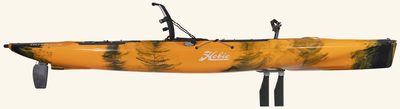
The Outback is the oldest pedal fishing kayak still in production, and that long history shows in how refined it is. Hobie's MirageDrive 180 moves fins side to side instead of spinning a prop, so the fins fold up flat against the hull in inches of water and kick up when they hit a stump. In weeds, fins slice through where a prop wraps up and stops, and that difference is the single best reason to pay Hobie's price.
The current boat is 12 feet 9 inches long and 34 inches wide. Hull weight is 85 pounds, rigged weight is 103 pounds, and capacity is 425 pounds. Owners mention the Vantage seat by name for back support, and the Guardian shield protects the sonar sensor under the hull from strikes. Reverse works through a shift-cable pull on the 180 drive, not instant back-pedaling, so holding on a spot takes a half-second longer than on a prop boat.
The price is the downside. Hobie's current list price is $3,599, though dealers still list boats at $3,299, so shop both numbers before you pay. The 425-pound capacity also runs out faster than the Old Town numbers once a bigger angler adds gear and a battery, and the bow can pound in choppy water, a complaint that runs through older Outback threads. Hobie Mirage Outback is the boat for the angler whose water is shallow, weedy, or full of timber.
Old Town Sportsman BigWater PDL 132 ~$3,250
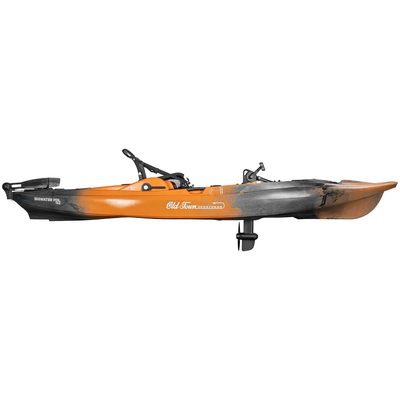
The BigWater PDL 132 is the PDL 120 stretched to 13 feet 2 inches and aimed at open water. Owners report sustained speeds around 4 to 4.5 mph, the fastest pedal numbers in this guide, and the longer hull holds a straighter line in wind and chop. It is 36 inches wide. Rigged weight is 122 pounds, and usable capacity is 378 pounds. It is also the boat big anglers keep choosing when the 120 feels small.
One owner warning belongs in any fair account of this boat. A long-term owner who loves it says the boat tips noticeably to one side as a warning before it goes over if you lean hard into a turn, and calls it a bit easier to flip than the 120 in that specific situation. Most owners report never tipping it, so read that as a handling note: keep your weight centered in turns. Owners also report the stock mounting plates wobbling, with solid aftermarket plates as the fix.
Do not confuse this boat with the paddle BigWater 132, which costs $1,399.99, weighs 86 pounds, measures 34 inches wide, and has no pedal drive at all. Old Town Sportsman BigWater PDL 132 is the boat for the angler who fishes reservoirs and big lakes and covers miles per trip.
Seastream Angler 120 PD ~$1,400–1,700
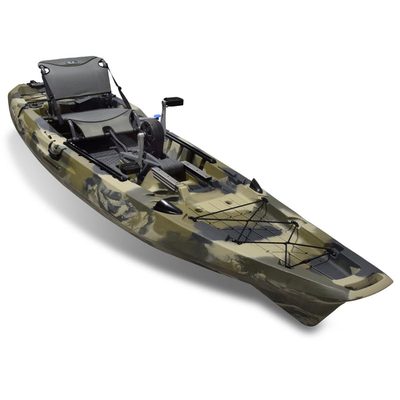
The Seastream is the only boat in this guide that gets owners excited about the price without apologizing for the boat. It is 12 feet 3 inches long and 35 inches wide. Hull weight is 97 pounds, and rigged weight is 119 pounds with the 22-pound Rapid Drive installed. It pedals forward and backward on demand, stands steady, and carries 400 pounds. The list price of $1,699 undercuts every premium pedal boat by a wide margin, and street prices run lower, around $1,300 to $1,400 where stock exists.
The complaints are fit-and-finish complaints, not drive failures. The seat locks into fixed positions instead of sliding freely, there is no dry storage hatch, and there is no recessed spot for a transducer, so a fish finder needs a mount in one of the hull's drain holes (a scupper mount) or a swing arm. At roughly 119 pounds rigged, it still needs a cart, and the hull warranty is shorter than Old Town's lifetime hull coverage.
That gap is exactly the deal: you give up some refinement and some warranty, and you keep roughly $1,000 to $1,500 in your pocket. Seastream Angler 120 PD is the boat for the angler who wants to learn whether pedal fishing is for them without spending premium money.
Native Slayer Propel 10 LTE ~$2,350
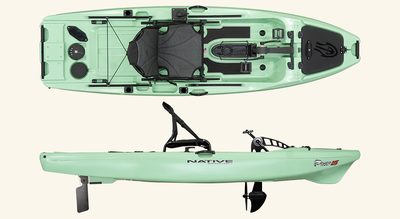
The Slayer Propel 10 LTE is the answer to the most common reason people sell pedal kayaks. It is 10 feet long and 34.5 inches wide. Hull weight is 65 pounds, and rigged weight is 85 pounds. It is the only premium pedal boat most anglers can load alone onto a roof rack or slide into a truck bed. The 701 Propel drive gives instant forward and reverse, the Springblade rudder fixes the slow-turning complaint that dogged older Slayers, and the hull carries a transducer pocket plus a Powerlink plate for a motor or anchor later.
The trade is space and speed. The deck is smaller than the 12-foot boats, taller anglers report feeling cramped, and the short hull gives up glide on open water. Note the name: the LTE is the current Slayer Propel 10 evolution, and the older Slayer Max 10 at around $2,749 is a different, heavier boat. Native Slayer Propel 10 LTE is the boat for the solo angler who fishes small water and loads alone.
What to skip
- Hobie Pro Angler (PA 12 and PA 14): superb standing platforms, but they weigh roughly 130 to 150 pounds rigged, cost roughly $3,900 to $5,900 depending on drive, and all but require a trailer. The 360 drive adds sideways movement and also adds steering-misalignment complaints and reports of water leaking into the hull from owners, mostly on early-generation drives. Buy a PA only if you already trailer and fish standing up most of the day.
- Perception Crank 10: sold as a recreational kayak with almost no fishing rigging: no accessory mounting rails (gear tracks), no flush rod holders, and a fixed prop mount that worries owners in a collision.
- Pelican Catch Kicker 110 HDII: light and cheap, and Pelican's parts service gets real praise, but it doesn't belong in this class — the 300-pound capacity is tight for bigger anglers plus gear, the boat is meant for calm water, and owners report fins and seat hardware breaking within months.
- Motor-assisted ePDL versions: the electric BigWater runs around $6,000, which is a different purchase from a pedal kayak.
Before you buy: three things that matter more than the badge
First, demo the drive before you pay. Pedal feel splits anglers cleanly: cyclists tend to love bicycle-style prop drives, while step-motion fin drives feel natural to others. One afternoon of demos tells you more than a month of reading.
Second, plan transport before you plan rigging. Anything over 100 pounds rigged wants a cart at minimum and a trailer if you fish alone often. Pull the drive and the seat out before you lift, since those two pieces drop a good part of the carry weight. And plan against usable capacity, not total capacity.
Third, match the drive to the water, not the brand: prop drives win deep lakes and instant reverse, while fin drives win weeds and shallow water. If you fish both, pick the water you fish most and accept the compromise on the other, or budget for a paddle as your shallow-water backup. For rigging order once the boat is home, our How to Rig a Fishing Kayak for Bass covers the sequence, and our Best Budget Fish Finders Under $300 covers the units that pair with these hulls. If you are still weighing paddle boats, our Best Fishing Kayaks for Bass Under $1,000 (2026) covers the paddle side.
Bottom line
The Old Town Sportsman PDL 120 is our top pick for most anglers, but pick the Hobie Mirage Outback if your water is shallow, weedy, or full of wood, and the BigWater PDL 132 if you fish big water and want speed with your stability. If the budget decides the boat, the Seastream Angler 120 PD gets you on the water for less, and if you load alone, the Native Slayer Propel 10 LTE is the one to carry. Whichever you pick, demo the drive, sort the cart, and check the usable capacity before you pay.