
A fish finder answers one question before anything else: what is under the boat, and is it worth fishing. Under $300, every unit makes a trade to hit the price. The trick is picking the trade you can live with, because the wrong one shows up every trip: a screen too small to read from the back of a kayak, a unit with no way to mark a brush pile and return to it, or a castable that drops its connection at 40 yards.
The four units below are the ones that held up across forums, owner reviews, videos, and blogs. Our pick if you buy one unit: the Garmin Striker Vivid 4cv, at about $200. If money is tight, the base Garmin Striker 4 at around $120 to $160 does the core job. If you fish big water and want real maps in the box, the Lowrance HOOK Reveal 5 SplitShot is the one. And if you fish from the bank, the Deeper PRO+ 2 needs no boat at all.
Garmin Striker Vivid 4cv ~$200
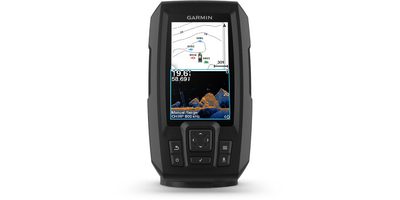
The Vivid 4cv is the Striker 4 grown up. It keeps the same simple button interface and a low power draw, though it draws more than the base unit (0.40 amps at 12 volts, versus 0.23), then adds the two things owners of the base unit say they miss most: ClearVü down imaging and Quickdraw Contours mapping. The included GT20 transducer sends CHIRP traditional sonar plus ClearVü, which draws a near-photographic picture of what sits directly below the boat: rock piles, grass edges, timber, and the fish holding on them. The 4.3-inch screen runs 272 by 480 pixels, and the Vivid color palettes keep the picture readable in bright sun, where cheaper screens wash out.
Quickdraw Contours is the feature that changes how the unit earns its keep. It draws 1-foot contour lines as you drive, building a map of water nobody has charted. On a farm pond or a small local lake with no commercial map, that is the whole game: after a few trips you have a chart of every hump and drop-off, made by your own boat. The GPS marks waypoints and routes, so a brush pile found in June is still findable in October.Two drawbacks: the 4-inch screen gets cramped on a split view, so run one view at a time, and like every Striker it ships with no preloaded maps and no way to add them. Quickdraw is the only map you get. If you fish big reservoirs and want a chart on day one, that points you at the Lowrance below. Garmin Striker Vivid 4cv is the unit for the kayak or small-boat angler who wants one purchase to last several seasons.
Garmin Striker 4 ~$120–160
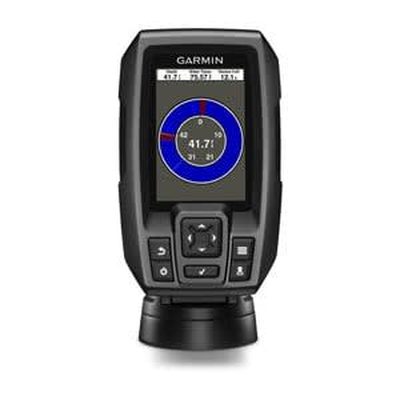
The base Striker 4 is the least expensive unit in this guide, and it has been for years. Its 3.5-inch screen runs 480 by 320 pixels, and it sends CHIRP traditional sonar through a dual-beam transducer, with GPS waypoints and a flasher mode for ice fishing. What it does not have is down imaging. That is the line between this unit and the 4cv above: the Striker 4 shows fish arches and bottom shape, not the photographic down picture.
What owners keep coming back to is how little fuss it makes. The keyed interface takes minutes to learn, it sips power (about 0.23 amps at 12 volts, so a small 7Ah battery runs it all day), and it survives kayak flips and years of use. One long-term owner ran the same unit for close to a decade across kayak, jon boat, and ice. The flasher mode is a real bonus: it turns a $130 unit into a passable ice unit in winter, which is why so many northern anglers own one as a second unit.The screen is the compromise: at 3.5 inches it is small on a boat console, fine on a kayak deck an arm's length away. The GPS is waypoints only, a blank field with dots rather than a lake map. One owner reported a screen-spot failure just past the one-year warranty, the exception in a long run of multi-year reports. Garmin Striker 4 is the unit for the angler who wants sonar and waypoints for the least money possible, or for anyone who wants a second unit for ice season.
Lowrance HOOK Reveal 5 SplitShot ~$275–300
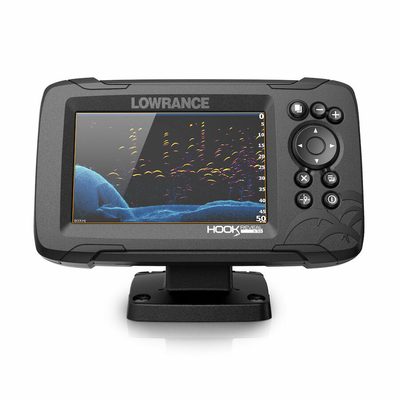
The HOOK Reveal 5 SplitShot is the pick for the angler who fishes structure on bigger water. Its 5-inch SolarMAX screen runs 800 by 480 pixels, the sharpest picture in this guide, and it pairs High CHIRP sonar with DownScan imaging. FishReveal layers fish arches over the DownScan picture, so a bass holding tight to a brush pile shows up on the structure itself instead of floating in open water on a separate view.
It also ships with the maps the Garmins lack. Preloaded C-MAP US Inland mapping covers about 4,000 lakes with 1-foot contours, and Genesis Live draws custom half-foot contours on water the preloaded map misses. Autotuning sonar adjusts settings as conditions change, which beginners praise because it removes the fiddling that puts new owners off.
It carries the heaviest caveat in this guide. A run of owner reviews reports hard failures: sonar that stops at random, screens that go black on first use, and transducers that quit inside six months, with slow warranty help. In one retailer's set of 15 reviews, five described hard failures rather than complaints about features. That is high enough to matter, and it is why this unit sits third instead of first despite having the best feature list. Buy it from a retailer with a plain return policy and test it hard in the first two weeks.
One more trap, and it is a naming trap. The cheaper HOOK Reveal 5x is the same screen with no maps at all, and no chart support to add them later. Anglers who got a 5x with a boat package or on sale found a white screen with a line where a lake should be. Check the box for the words SplitShot and US Inland mapping before you pay. Lowrance HOOK Reveal 5 SplitShot is the unit for the structure angler who wants real maps and the clearest picture, and who will test it early.
Deeper PRO+ 2 ~$160
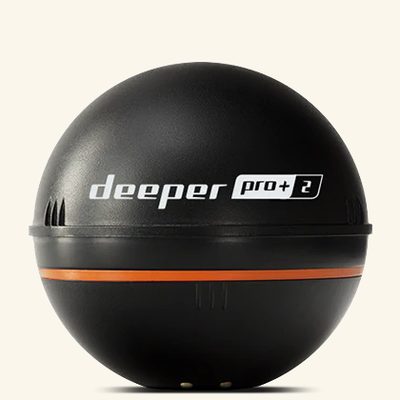
The Deeper PRO+ 2 is a sonar ball, not a console unit. Tie it to your line, cast it out, and it sends depth, structure, and fish marks to your phone over its own Wi-Fi signal. It scans to 330 feet deep with a 330-foot casting range, runs about nine hours on a charge, and carries built-in GPS, so it draws bathymetric maps from the bank as you reel it in. For a bank angler or a pond hopper, that is a combination no mounted unit can match. It also works on ice, which makes it a genuine four-season tool.
The three-beam sonar separates targets down to 0.4 inches on the narrow beam, fine enough to watch a jig and a following fish as separate marks. Owners use it to map a pond from shore, then fish the drop-offs they found on the phone screen. It weighs 3.2 ounces, so it needs a stout rod to cast well, and it is not a replacement for a mounted unit on a boat: a phone screen in bright sun and a battery that also runs your calls are compromises a console unit never asks you to make.
The Wi-Fi link is the thing to get right on day one. The most reported problem is dropped connections, and the usual cause is the phone itself: iOS Wi-Fi Assist and Android's smart network switching cut a connection that has no internet, which is exactly what the Deeper's signal is. Turn that setting off before the first cast and most of the drop complaints disappear. Range also falls off past 40 to 50 yards for some owners, so treat the 330-foot casting range as a best case, not a promise. Deeper PRO+ 2 is the unit for the angler without a boat, or with a boat they will not modify.
What to skip
Skip the cheapest Humminbird portables for bass fishing. The PiranhaMAX 4 is fine for trolling or bait fishing, but owners who jig with it report they cannot reliably see a jig or a fish following it, and the portable kit is heavy to carry. Skip side imaging at this price: no new unit under $300 does it well, and the ones that claim it need boat speed a kayak rarely holds to draw a clean picture. Skip the Garmin 7-inch Strikers for this budget. The 7cv and 7sv are better screens with the same no-preloaded-maps limitation, and they cost $400 and up.
Before you buy: three things that matter more than the screen
First, the transducer mount decides whether a budget unit looks good or bad. Mount it in clean water, parallel to the surface, away from strakes and turbulence. More budget-unit complaints trace back to a transducer in dirty water than to the electronics in the box. On a kayak, a scupper mount or a deployment arm beats a rushed transom job, and our How to Rig a Fishing Kayak for Bass covers the order to do it in.
Second, budget for power on a kayak. The Garmins sip power and run all day on a small sealed battery, which is part of why they dominate kayak threads. The Lowrance draws more, so size the battery up or carry a spare. The Deeper charges over USB and runs about nine hours, so a phone charger in the dry bag covers it.
Third, decide what maps mean to you before you pay. If you fish one or two small waters, Quickdraw Contours on a Garmin builds you a better map than a preloaded chart of lakes you never visit. If you fish new reservoirs every weekend, preloaded maps on the Lowrance save you the season it takes to draw your own. That single choice splits this guide in half. For hull ideas to put any of these on, our Best Fishing Kayaks for Bass Under $1,000 (2026) covers the boats these units were built around.
Bottom line
Buy the Garmin Striker Vivid 4cv if you want one unit that does the most for about $200. Buy the base Striker 4 if the budget is the whole decision. Buy the Lowrance HOOK Reveal 5 SplitShot if you fish structure on big water and want maps in the box, and test it hard in week one. Buy the Deeper PRO+ 2 if you fish from the bank. Whichever you pick, mount the transducer right and learn what a brush pile looks like on the screen before you worry about a bigger one.