The biggest fish in the river that most anglers never try for
A flathead catfish is the largest freshwater predator most anglers will ever have a real shot at, and it lives in water you probably already fish. A 30-pounder is a great fish anywhere, a 50-pounder is not unusual where the population is mature, and the world record stands at 123 pounds. That fish came out of Elk City Reservoir in Kansas in May 1998, caught by Ken Paulie while he was crappie fishing.
The short version: put a lively baitfish on a heavy slip-sinker rig, set it tight against a logjam or undercut bank after dark, and wait. Flatheads hunt live fish, so the whole game is bait, cover, and patience.
How to tell a flathead from a channel or a blue
Three big catfish share most of the same water, and the mix-up matters because they eat differently. Channels and blues will take cut bait and stink bait. A flathead will mostly ignore both.
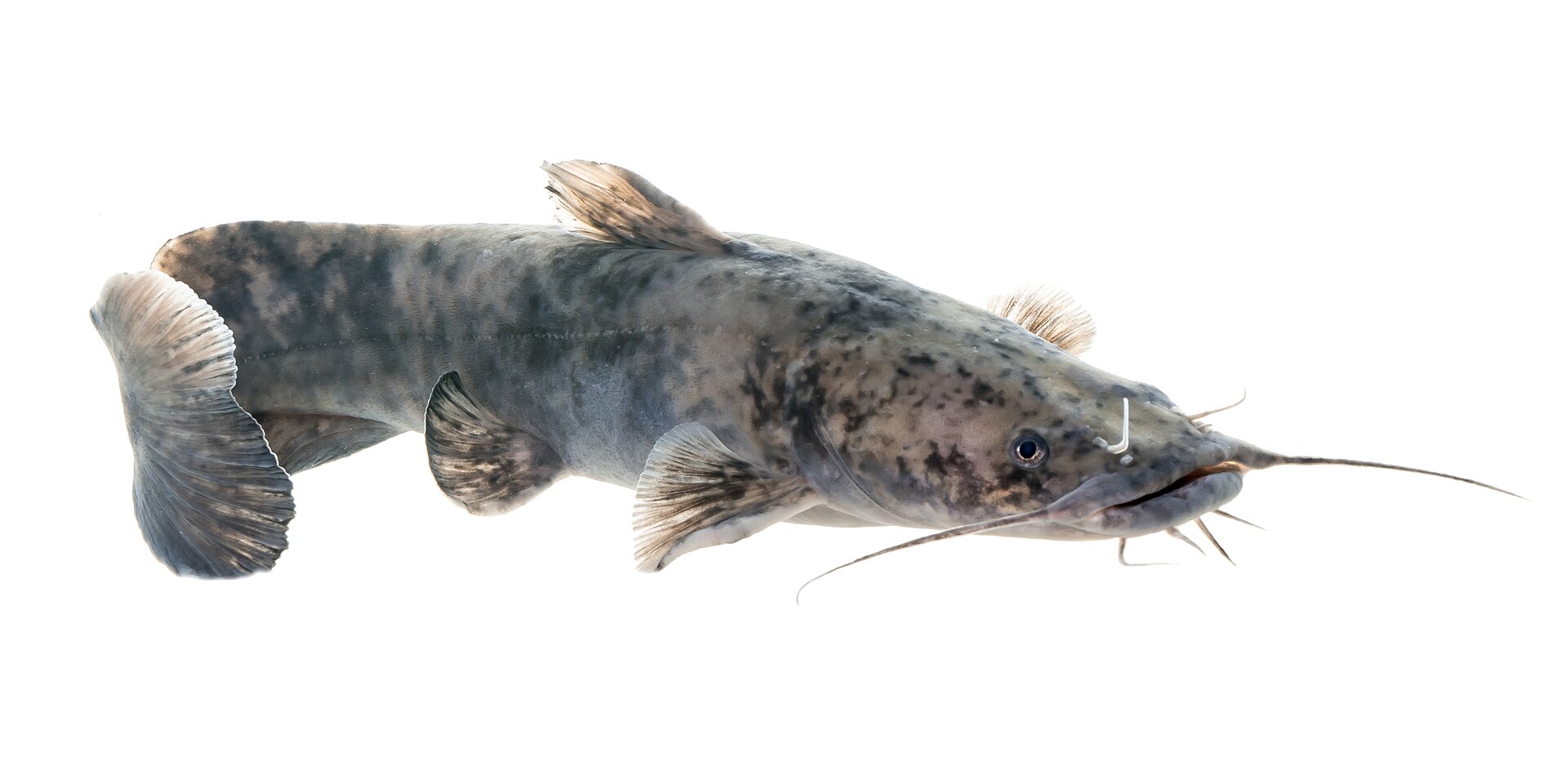
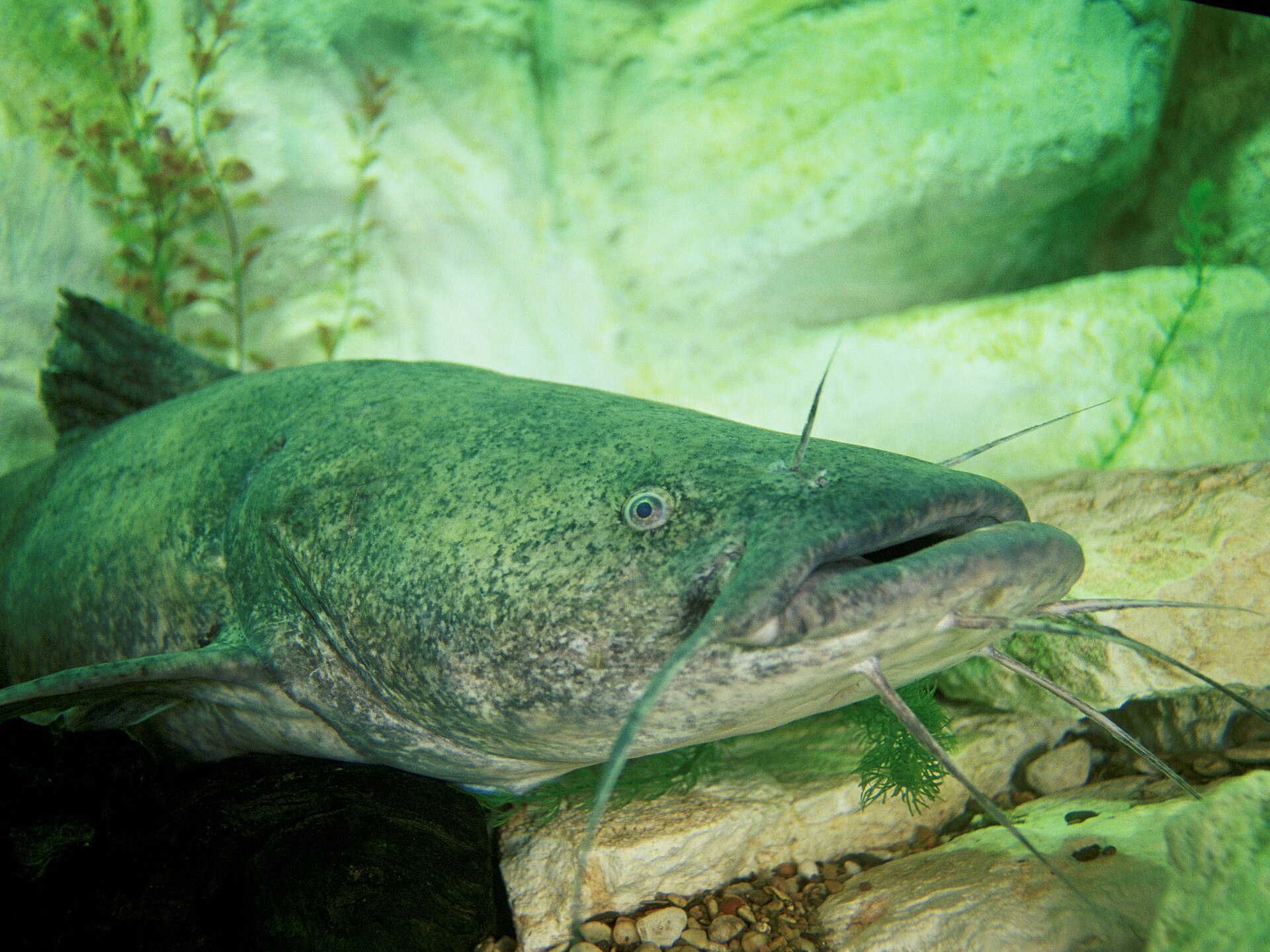
The jaw. A flathead's lower jaw sticks out past the upper jaw, the only one of the three built that way. Its head is broad and flat, which is where the name comes from.
The tail. A flathead's tail is slightly notched, almost square at the corners. Channels and blues both have deeply forked tails. If the tail is not forked, it is a flathead.
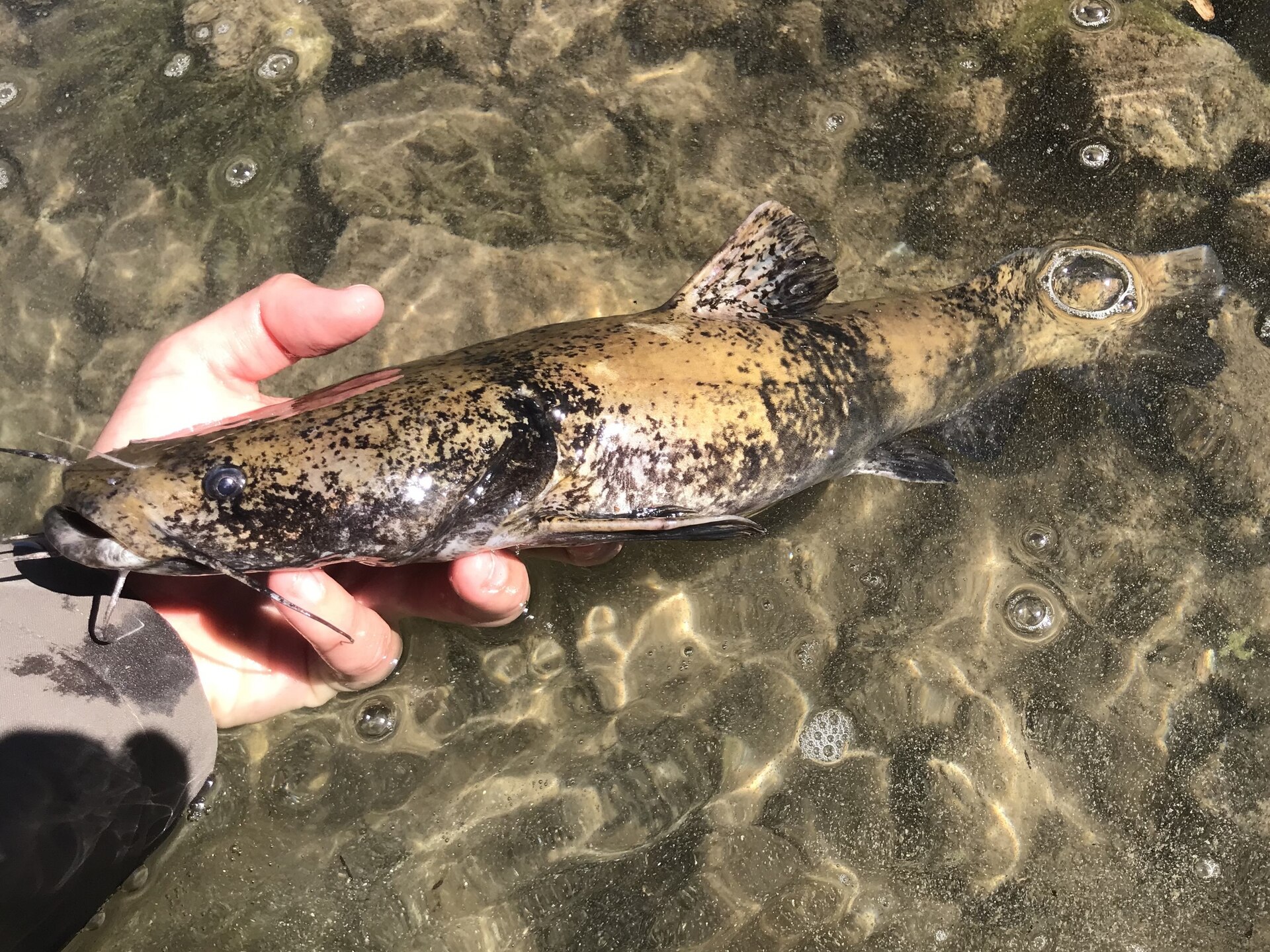
The color. Flatheads are mottled yellow-brown with a pale belly, a camouflage pattern meant for a logjam. Young channels are spotted and most big adults lose the spots, so color alone will fool you. Trust the jaw and the tail instead. Our Channel Catfish Basics guide covers the other two fish in detail, including the anal-fin ray count that settles channel versus blue.
Where they live
A flathead is a homebody. Adults are solitary, and each one stakes out a favorite spot, a deep hole with heavy cover, and returns to it year after year. Radio-tagging research cited by In-Fisherman found summer flatheads staying nearly still for up to 23 hours a day, feeding only at night. John Trager, a Kansas City guide, recognizes repeat fish by their hook marks and greets the same flathead in the same hole season after season.
In rivers, find the wood. Logjams, root wads, submerged trees, and undercut banks are the whole game. Work the outside of a bend, where the current cuts a deep bank, and the deep hole below a dam or wing dike. Cast within a few feet of the structure, not 20 feet out in open water. A flathead sits in the slow water beside the current and waits for food to drift past.
Below dams, fish the seam. A current seam is the line where fast water meets slow water, and it is the best spot in a tailrace. The scour holes below a dam change from year to year, so re-scout with a depth finder each season instead of trusting last year's map. In Kansas, the rock dam at Lawrence and the weir in Kansas City both hold flatheads in exactly this kind of water.
In lakes, find the creek channel. Reservoirs hold flatheads along submerged creek channels, timber, and points near running water. Deep water plus heavy cover is the rule. A bare, featureless stretch of shoreline is a waste of a night.
Day means deep in cover, night means shallow. By day a flathead is tucked into its logjam, nearly motionless. After dark it slides out onto flats, bars, and riffles to feed, often in only five or six feet of water.
What they eat
A flathead is a hunter, not a scavenger. Young fish eat insects and crayfish, but once a flathead passes about ten inches long, its diet is entirely live fish: shad, carp, suckers, sunfish, and other catfish, including its own kind. Minnesota DNR puts it plainly: flatheads generally shun dead bait and stink bait. That is the first mistake to skip. The chicken liver and stink bait that catch channels will sit untouched while a flathead waits for something alive.
The bait ranking. Green sunfish are the premier bait, named by more guides than any other. They are tough, they fight the hook constantly, and that struggling sends vibrations through the water that a flathead picks up with its lateral line, the row of sense organs along its side that detects movement. Bluegill are the classic co-number-one, nearly as hardy and easy to catch yourself. Bullheads are the top trophy bait: hardy enough to stay lively for hours on the hook, best at six to eight inches long, with the sharp spines clipped off with pliers first. Suckers, chubs, and shad all work too. The answer from the forums is that the best bait is whatever the local fish are already eating.
Hook the bait so it can swim. Hook a live baitfish just behind the dorsal fin, the fin on its back, so it fights to stay upright and kicks hard in the current. A bait hooked through the nose spins in current and tangles itself. A lively bait matters more than the species: one forum angler put it as "if the bait is kicking good, I don't care if it is a skipjack, bluegill, bullhead, whatever. It is that movement that attracts the flathead."
Check the bait laws first. Live-bait rules vary by state. Minnesota bars bluegill as bait, and goldfish rules differ from state to state. Check your state's regulations before you fill the bait bucket. Fresh cut bait can also catch flatheads, especially in fast water where the scent carries downstream, but it is the backup plan, never the first choice.
The rig
The default flathead rig is a slip-sinker rig, also called a Carolina rig. A heavy sinker slides freely on the main line above a swivel, and a short leader runs from the swivel to the hook. The fish can pick up the bait and move off without feeling the weight of the sinker.
Build it like this. Start with 50 to 80 pound braided main line. Thread on a no-roll sinker, a flat sinker that holds bottom in current instead of rolling downstream, in the three to six ounce range. Four ounces is a good river starting point, and heavy current below a dam can call for eight. Add a plastic bead to protect the knot, then a heavy barrel swivel in the 100 to 200 pound class. Tie on a leader of 50 to 80 pound monofilament, 8 to 18 inches long, and finish with a snelled 8/0 or 10/0 hook. A snelled hook is one tied with the line wrapped around the shank, which keeps the point in the right position to catch the corner of the mouth.
Two variations are worth knowing. A Santee Cooper rig adds a small foam float, called a peg float, on the leader to lift the bait a few inches off the bottom. A three-way rig runs the sinker on a lighter dropper line off a three-way swivel, so a snag costs you only the sinker.
Keep the leader short. Eight to 18 inches is the range the forums and guides agree on. A longer leader tangles more and lets the bait swim into the wood.
Circle hooks, Kahle hooks, and J-hooks
This is the one real argument in flathead fishing, and it is genuinely unsettled. All three hook styles catch fish, and experienced anglers split roughly evenly.
Circle hooks have a point that curves back toward the shank, and they work by rotating into the corner of the fish's mouth as the line comes tight. You do not set the hook. You let the rod load up and reel. Their big advantage is release: a circle hook almost always catches the corner of the mouth, so unhooking is quick and the fish swims off clean. Their drawback is the learning curve. If you jerk to set a circle hook, you pull it straight out of the fish's mouth. And in still water, a flathead swimming toward you leaves no tension to turn the hook.
Kahle hooks are the compromise, shaped halfway between a circle and a J-hook, and much cheaper than premium circles. You set them with a light sweep of the rod instead of a hard jerk. Several guides use them as their default, including Robby Robinson, a southeast Ohio reservoir guide with more than 1,400 flatheads to his name.
J-hooks are the traditional open-point hook, and the J-hook camp sets the hook hard the moment the fish commits. Their argument is control: you decide when the hook goes in, before the fish turns back into the brush with your bait. Their cost is deep-hooking, which is why the circle-hook camp switched in the first place.
Our read of the evidence: start with an 8/0 circle hook on a slip-sinker rig and learn to let the rod do the work. If you fish still water where flatheads swim toward the boat, or you keep missing fish you know are there, try a Kahle. Either way, match the hook to the bait, not the fish. A six-inch bullhead needs an 8/0. A small sunfish fishes better on a 5/0.
The rest of the gear
Flathead gear is heavy on purpose. A big flathead's first move is a violent run for the wood, and light tackle cannot stop it.
Rod. A seven to eight foot heavy-power rod, baitcasting or spinning, with enough backbone to pull a 30-pound fish out of a logjam. Fiberglass rods are popular because they bend deep and absorb the head shakes instead of passing every jolt to the line.
Reel. A baitcasting reel with a clicker, a switch that lets line pay out with an audible clicking sound while the reel is in free spool, so a flathead can run with the bait before you engage the drag. A spinning reel with a bait-feeder feature does the same job. Either way, the reel needs a strong drag and a big line capacity.
Line. Fifty to 80 pound braid for the main line, with a 40 to 100 pound monofilament leader. Braid has almost no stretch, so you feel the take, and it is thin enough to cut current. The leader takes the abrasion from rocks and wood.
The rest of the kit. A headlamp with a red mode, so you can see your rig without shining white light on the water. A big landing net. Pliers for hook removal and for clipping bullhead spines. A bait bucket with an aerator, because a dead baitfish is a wasted cast. And a plan for the night: launch before dark, mark hazards while you can still see them, wear a life jacket, and tell someone where you are fishing.
When to fish
The night windows. Dusk is the first and best window: the 60 to 90 minutes after sunset, when flatheads slide out of cover to feed. A second push comes around midnight, and a third just before dawn. Sunset to 2 a.m. is the most productive stretch overall. Our Night Fishing for Bass guide covers the same after-dark routines, and the habits transfer directly.
The season. Feeding starts in earnest when the water passes about 60 degrees in spring, and summer feeding peaks above 70 degrees. The spawn slows the bite in early summer: the fish are in hollow logs and undercut banks guarding nests, and males fan the eggs for days without feeding. Spawning runs from late May into August depending on the region, triggered when the water hits roughly 72 to 80 degrees. After the spawn, flatheads feed hard to bulk up, and fall is a strong window before they shut down for winter. Below about 50 degrees they go nearly dormant in deep holes.
The weather. Rising water after rain is a good trigger, because it washes food into the river and stirs the fish up.
How to fish a spot
Give each spot 30 to 45 minutes. If nothing has touched the bait by then, move. The fish either lives in that logjam or it does not, and sitting on a dead spot for hours is the most common beginner mistake. The exception is a trophy hunt: when you are fishing for one big fish in a known hole, leave the bait soaking an hour or more and do not move it. Flatheads do not feed every night, and the big ones are in no hurry.
Fish the bait beside the wood, not in it. Cast so the bait lands a few feet from the logjam, not buried inside it. A bait in the middle of the tangle snags before a fish finds it.
Refresh the bait. Swap in a fresh baitfish every 15 to 30 minutes. A tired bait stops kicking, and a bait that stops kicking stops attracting flatheads.
Watch the rod tip, not the clicker. A flathead take is often a slow, steady pull, sometimes just a few inches of rod-tip bend, not the screaming run a channel cat makes. When the rod loads up, reel down steadily until the line is tight and the rod is bent. Do not jerk. If you are fishing a circle hook, the rod loading is the hookset.
The fight is violent but rarely long. A big flathead does not make long runs. It pulls hard, shakes its head, stays upright, and digs for the bottom and the wood, and most are won or lost within a few minutes. Keep steady pressure and keep the fish out of the cover. Once it turns and comes up, it is mostly done.
Landing and releasing a big one
A 40-pound flathead is too heavy to hang by its jaw. Support a big fish with one hand under the jaw and the other under the belly, keep it in the water as much as possible, and release it quickly. Do not lip-grip a fish over five pounds, and never hold a big flathead vertically by the jaw alone. Circle hooks make unhooking easy, since the hook is almost always in the corner of the mouth, and a long pair of pliers reaches it without putting your fingers near the teeth. Their pectoral and dorsal spines are sharp, so grip behind the gill plate and stay clear of the fins.
Release the big ones. A 40-pound flathead is a dozen-plus years old, some live into their 20s, and it holds the same hole year after year. The next angler who fishes that logjam is fishing for the same fish.
Mistakes to skip
Light tackle. A bass rod and 12 pound line will hook a flathead. It will not land one. The fish will take the bait into the wood and break you off.
Dead or stink bait. Flatheads hunt live fish. The tub of cheese bait that fills a stringer of channels is a waste of a cast here.
Setting a circle hook. The single most repeated piece of advice in every forum thread is also the hardest to follow: do not jerk. Reel down and let the rod load.
Fishing the middle of the river. Flatheads sit in the slow water next to the current, not in the current itself. Cast to the seam and the wood.
Sitting on a dead spot. Thirty to 45 minutes without a touch is the signal to move. The fish is not coming.
Burying the bait in the wood. Beside the logjam, not inside it. Snags are the price of admission, but you do not have to pay it on every cast.
The bottom line
A flathead is a simple fish to understand and a hard fish to catch. It lives in one logjam, eats live fish, and feeds after dark. Bring a lively baitfish, heavy tackle, and a slip-sinker rig, set it beside the wood, and give the spot 30 to 45 minutes. Do that on enough nights and the rod will bend on a fish that makes every bass you have ever caught feel small.