The weakest link is the knot
Every fish you hook is held by one knot. The rod, the reel, the line, and the hook all funnel down to a few wraps of line cinched tight against a hook eye. A bad knot fails at less than half the line's rated strength, and it usually fails on the best fish of the day.
Five knots cover nearly every connection a bass angler makes. The Palomar ties on a hook or lure. The improved clinch does the same job on mono and light fluorocarbon, and it fits lures the Palomar cannot. The non-slip loop lets a lure swing free. The FG joins braid to a fluorocarbon leader. The snell ties a flipping hook to its shank. Learn these five and you have every core bass connection covered.
Before you tie anything
A few words show up in every knot description, so get them straight once. The standing line is the part running back to your reel. The tag end is the short free end you work with. A bight is a doubled loop of line, folded back on itself. Cinch means to pull the knot tight and seat it, which is the step where most knots fail.
Four rules apply to every knot here. Wet the knot before you cinch it, with spit or water, because dry line heats up from friction as the wraps slide together. Pull slowly and steadily, never with a jerk. Keep the wraps neat and side by side, never crossed over each other. Test every knot with a hard pull before you cast, and if it looks wrong, cut it off and tie it again.
One argument runs through every knot thread: wet the knot or tie it dry. Most anglers wet every knot, and the expert sources agree. A vocal minority argues that saliva lets a noose-style knot keep digging into itself and cutting itself. Salt Strong tested it directly: knots tied without saliva came out about 8 percent stronger on fluorocarbon, while knots tied with saliva came out about 12 percent stronger on mono, and the testers called the result inconclusive. We wet our knots. If you fish heavy line, try both and pull-test them yourself. Either way, the through-line in every knot argument is the same one an old Western Bass poster put best: the best knot is the knot you can tie properly under fishing conditions.
The Palomar: the default
The Palomar is the first knot to learn and the one most anglers end up tying most. It works on mono, fluorocarbon, and braid, it takes seconds to tie, and in Tom Rowland's machine tests it kept 94 percent of 20-pound fluorocarbon. On braid it is the standard terminal knot, the one nearly every forum thread recommends first.
- Double six to twelve inches of line into a bight and pass the bight through the hook eye.
- Tie a loose overhand knot with the doubled line, hook hanging below.
- Pass the hook, lure, or swivel through the loop that is left.
- Slide the loop up above the eye so it sits over the overhand knot.
- Wet it, then pull the standing line and the tag end together, evenly and slowly, until the loop closes down over the overhand against the eye.
- Trim the tag to about an eighth of an inch.
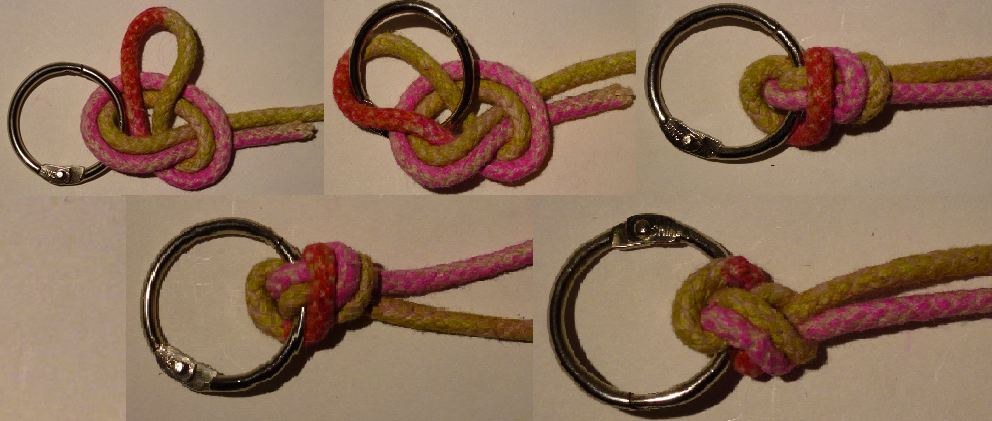
Two details decide whether a Palomar holds. The two strands inside the eye must sit flat next to each other, not crossed, because fluorocarbon is hard enough to cut itself where it crosses. And never pinch fluorocarbon to thread the eye: run one strand through, then run it back through from the other side, since pinching deforms the line right where the knot takes the load. The Palomar has two real limits. A lure has to pass through the loop, so big treble-hooked crankbaits and jerkbaits do not fit. And it wastes line, since every re-tie costs six inches or more of doubled line.
Where it is argued about: Palomar on fluorocarbon is the hottest split in knot forums. One camp has never had one fail. The other says it is easy to tie wrong on fluoro and points to the San Diego Jam instead. The middle ground is that the Palomar is fine on fluoro if it is tied perfectly: no crossing, no pinching, and wet, pulled down evenly.
The improved clinch: the mono classic
The improved clinch is the knot most anglers were first taught, and it is still the right call on mono and light fluorocarbon. It is small and fast, and it fits lures the Palomar cannot: spinnerbaits, big treble topwaters, jerkbaits, and crankbaits, anything too big or too treble-heavy to pass through a doubled loop. In Rowland's tests on 20-pound fluorocarbon it kept about 87 percent.
- Pass the tag through the eye, leaving six to eight inches to work with.
- Wrap the tag around the standing line five to seven times, working away from the eye: five wraps is standard, seven on light line, four on heavy line.
- Pass the tag back through the small loop beside the eye.
- Pass it back through the big loop you just created. That second pass is the "improved" part, and it is worth a lot: on the same 12-pound fluorocarbon, Rowland's plain five-turn clinch kept 65.6 percent of the line's true breaking strength while the improved version kept 90.5 percent.
- Wet the knot, seat it by pulling the standing line rather than the tag, and trim to about an eighth of an inch.
The clinch has one hard rule: never tie it on braid. It slips, and every source we read agrees. Field and Stream's eight-turn clinch in braid slipped out at about 10 pounds on 14-pound line. Anglers who switched from mono to braid while keeping their clinch lost fish and tackle before they figured out why. Use the Palomar or the snell on braid instead.
The non-slip loop: let the lure move
Some lures need to swing. A jerkbait, a walking topwater, or a crankbait tied tight to the line loses action, because the knot holds the lure nose-down and stiff. The non-slip loop, also called the Kreh loop after Lefty Kreh, fixes that with a fixed loop at the lure eye that the lure can pivot on. It kept 83 percent of 10-pound fluorocarbon in Field and Stream's test, which is plenty for a knot whose job is movement, not brute strength.
- Tie a loose overhand knot three to four inches from the tag end.
- Pass the tag through the lure eye, then back through the overhand loop.
- Slide the overhand down toward the eye and pinch it there.
- Wrap the tag around the standing line four or five times, all in the same direction.
- Pass the tag back through the overhand loop from the top, entering on the same side it came out of.
- Wet it, cinch by pulling the main line, and trim. The loop should end up about the size of a small candy: big enough for the lure to swing, small enough that it cannot tangle around a hook.
The wrap count depends on the line: seven turns on 6 to 8 pound line, five on 8 to 12 pound, four on 15 to 40 pound, three on 50 to 60 pound, and two over 60 pound. The sequence matters more than the count. The tag must re-enter the overhand on the same side it exited, or it sticks out sideways and snags grass. Use the loop knot only where the lure needs the freedom. If the lure has a split ring, the ring already gives it that freedom, so tie a snug knot instead. The same goes for live bait and for jigs in heavy cover. In Salt Strong's loop-knot contest the Rapala loop was slightly stronger than the Kreh, but the Kreh won overall on ease of tying and weedlessness, because its tag end points toward the lure instead of away from it.
The FG knot: braid to leader
Modern bass fishing runs braid main line to a fluorocarbon leader, and the FG is the join that makes that setup work. It is the thinnest and strongest braid-to-leader knot, slim enough to pass through the rod guides on every cast, and in Salt Strong's contests it beat the Alberto by well over 30 percent and the double uni by up to 30 percent. In Rowland's testing the leader itself broke before the knot did. Our Best Braided Line for Bass Fishing guide covers what to spool, and our Best Fluorocarbon Leader Line for Bass guide covers the leader side of this connection. It is also the hardest knot on this list, so tie it at home first. One angler in the forums said it took fifteen or twenty tries before it clicked, and that is normal.
- Tension the braid first and keep it under tension the whole time. Wrap it around your pinky a few times, hold it in your teeth, or set the rod in a holder.
- Lay the leader across the braid at a right angle.
- Wrap the leader around the braid, alternating one wrap away from you and one toward you, so the braid coils around the leader into a crisscross plait: sixteen to twenty wraps is the usual range for bass line, fewer on heavy line, more on fluorocarbon because it is harder and the braid has less to bite into.
- Compress the wraps every few pairs so they stay tight together, then lock the coils with half hitches around both lines.
- Pull hard, hard enough that the braid visibly bites into the leader and turns opaque or glossy on every turn. Use gloves or knot pullers on heavy line, because braid cuts skin.
- Cut the leader tag close, but only after tensioning, because the coils slide up when the knot is cinched. Finish with a few more half hitches around the braid only.
Under-tightening is the number one FG failure, and the anglers who tie it well say to pull until you think you might break the line, then pull more. The FG is worth the trouble when the connection has to pass through the guides all day, on long casts with a leader. On a rocking boat, in the wind, with cold hands, it is a slow knot, and plenty of good anglers use the Alberto instead, which ties in sixty to ninety seconds and is close enough for most bass fishing.
The snell: flipping and punching
The snell is the specialist. It ties the line to the hook shank instead of the eye, so the pull runs straight along the hook, and it is the knot for flipping, pitching, and punching heavy cover with a straight-shank hook. It is also the knot for circle hooks and live bait. Our Best Fishing Hooks for Bass guide covers the straight-shank flipping hooks this knot is made for.
- Pass the tag through the hook eye from the front, the point side. Threading it from the back creates a reverse snell, which ruins hooksets, and it is the most common snell mistake.
- Run the line down the shank past the bend and form a large loop behind the hook, with the tag coming back up behind the shank.
- Pinch the loop to the shank just behind the keeper and leave about four inches of tag to work with.
- Wrap the tag around the shank and the line, working from the point toward the eye, keeping the wraps even and never overlapping. Five to seven wraps is standard.
- Feed the tag back through the loop, underside to topside, and lay it along the shank.
- Lubricate, hold the wraps in place, and pull the tag and the standing line to tighten. Slide the wraps up snug against the eye and trim.
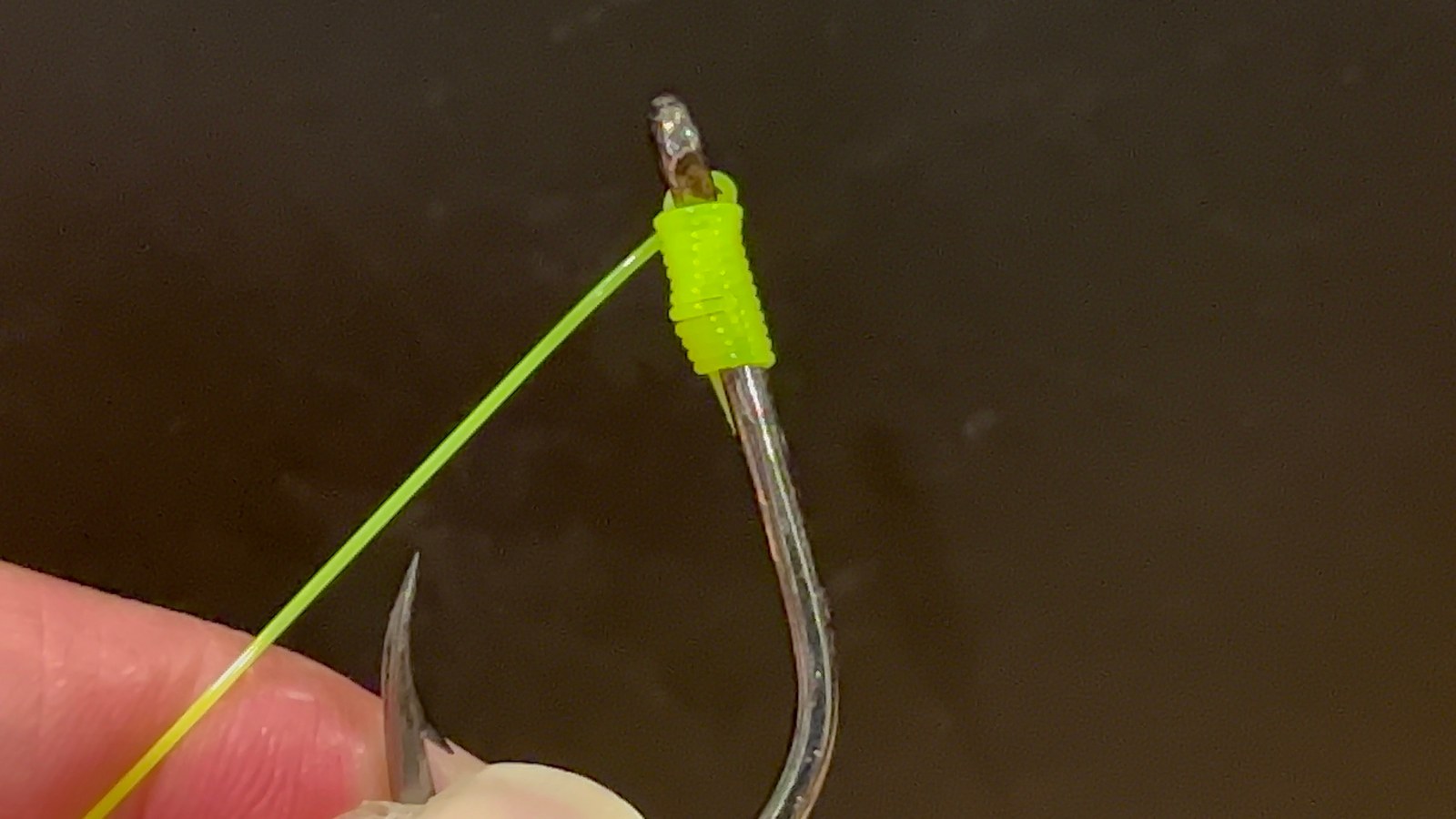
Two requirements are not optional. The hook eye must be closed or welded, because line slips through the gap of an open eye on the hookset. And the hook should be straight-shank, or the wraps have nothing clean to grip. Typical line is 17 to 25 pound fluorocarbon or 50 to 80 pound braid. One more benefit: the knot sits on the shank behind the weight, so a tungsten weight sliding down cannot hit the knot the way it can on a Palomar.
Where it is argued about: the standard belief is that the snell kicks the hook point up on the set, which is why it hooks better in thick cover. Hook specialist Bo James disagrees, arguing the kick rotates a straight-shank hook out of proper position. No published head-to-head pull test for the snell was found in any source we read, so the strength figures in knot charts are claims, not measurements.
How to actually learn them
Knots are learned in the hands, not on the page. Start at home, with a hook and a length of old line, not on the water with a fish waiting. Tie the Palomar and the improved clinch first. They are the two you will use most, and both are simple enough to learn in one sitting.
Then tie each knot ten times in a row and pull-test every one. Hold the hook and pull the standing line hard, the way a fish would. A good knot holds. A bad one slips or pops, and you will feel the difference in your hands before you see it.
The bottom line
Five knots, learned in the order in this guide. The Palomar first, because it ties on nearly anything and it is the braid default. The improved clinch next, because it is the mono classic and it fits the lures the Palomar cannot. The non-slip loop earns its place when a lure needs to swing. The FG covers braid to leader, and the snell covers heavy cover. Tie each one ten times at home, pull-test every knot before you cast, and retie anything that looks wrong. The knot is the cheapest part of your setup and the only part that holds the fish.