
A PFD (personal flotation device) only works if you wear it, and most kayak anglers do not wear theirs. The reasons repeat across every forum and thread we read: bulky vests fight the seat back, hot vests make summer miserable, and cheap vests chafe by hour two. The fix is not willpower. It is a vest designed for a kayak seat, bought once, in the right size.
The five vests below held up across forums, owner reviews, videos, and blogs. Our pick: the NRS Chinook, at about $140 to $180, the default answer in kayak fishing for a reason. The Stohlquist Fisherman is the runner-up owners keep the longest, at about $150 to $170. The Onyx MoveVent Dynamic is the budget pick that actually works, at about $54 to $80. The Astral V-Eight Fisher breathes best for southern summers, at about $115 to $165. And the Mustang M.I.T. 100 is the inflatable for anglers who will not wear foam, at about $130 to $185, with a safety section below to read first.
Wear the PFD, do not stow it. That line matters twice for inflatables, which only count as your legal PFD while worn.
How to choose
Seat fit first. A kayak seat has a tall back, and a standard vest's foam bunches against it, shoving the vest up around your ears. Every vest here has a high mesh back, a back panel cut short with mesh where the seat back sits. If you fish from a pedal-drive kayak with an especially tall seat, try the vest on in the seat before you commit. Two owners reported the Chinook's upper-back foam interfering with high-back pedal seats.
Foam or inflatable second. Foam floats you the instant you hit the water, with no mechanism to arm, maintain, or fail. It is the right choice for beginners, cold water, moving water, and anyone who fishes alone. Inflatables are barely there until they fire, which is why people who hate vests actually wear them. But every deployment costs $25 to $35, the CO2 cartridge and inflator need scheduled checks, auto-inflate can fire from rain or a wet hatch, and most are only legal PFDs while worn. Read the inflatable section below before you decide.
Pockets third. On a kayak, your vest is your tackle station. The fishing-specific vests here have fold-down pockets sized for small tackle boxes, plus plier sheaths and lash tabs. If you carry a lot of tackle, pockets decide the pick. If you run lean, they are dead weight and heat.
Fit fourth, and it is not optional. A vest that rides up is a vest you will take off. Measure your chest, check the brand's size chart, and cinch the side straps until the vest stays put when tugged upward. The best vest in the world does nothing folded behind your seat.
The picks
NRS Chinook ~$140–180
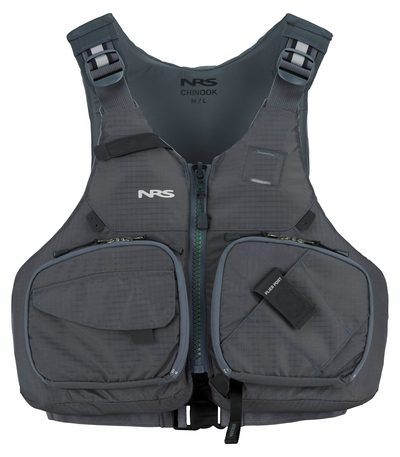
The Chinook is the default answer in kayak fishing, and the research says the default is right. Owners keep praising the same things: the pocket system they call a wearable tackle box and the high mesh back that clears kayak seats, worn comfortably all day. Two large clamshell pockets swallow small tackle boxes, a tool-holder pocket takes pliers or line cutters, and a rod holder loop keeps a spare rod off the deck. The seat clearance theme showed up in 4 of 6 REI reviews independently, from owners aged 18 to 75. Long-term owners report 4 and 5 years of use, and one Texas angler wears his in 107-degree heat.
NRS lists the current model at $179.95, with 15.75 pounds of flotation in size M/L and a USCG Type III rating. NRS Chinook is the vest for the kayak angler who wants one purchase to cover everything and pockets to organize it.
Three downsides. It is bulky and warm next to the low-profile picks below; three owners called it hot in summer, and one fished it two years before switching to an inflatable. It costs a lot more than the Onyx. And the upper-back foam can collide with tall pedal-drive seats, so sit in your seat with it on before the return window closes.
Stohlquist Fisherman ~$150–170
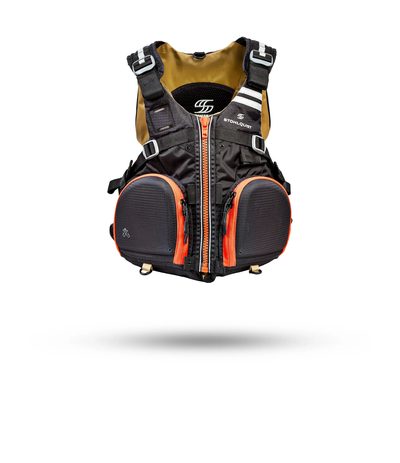
The Fisherman is the Chinook's oldest rival, and the one owners keep the longest. A BassResource owner was on his fourth year of heavy use with zippers and straps still perfect, and multiple owners describe forgetting they have it on. The EVA tool pouches, stiffened pockets on the chest, fold down into work surfaces for tying knots and swapping lures. Graded sizing, Stohlquist's system of scaling the foam to body size, gets consistent praise for fit. It is USCG Type III with 16.75 pounds of flotation, and Stohlquist lists it at $169.99. Stohlquist Fisherman is the vest for the angler who buys once and fishes for a decade.
Two downsides. The EVA pockets are rigid, so oversized fly boxes do not fit the way they do in the Chinook's soft clamshells. And one long-term owner had a drop-down pocket zipper break and moved to NRS over it. That is a single voice against years of durability reports, but it is worth knowing.
Onyx MoveVent Dynamic ~$54–80
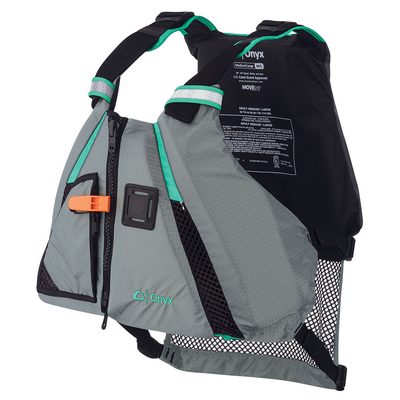
The MoveVent is the vest that makes the "I'll just wear the cheap one" plan actually work. At about $60 on Amazon, it is a third of the Chinook's price, with 4.8 stars across thousands of Amazon ratings and real kayak-seat clearance from its high mesh back. Owners praise the adjustability: 3 of 7 reviewers we read described a near-custom fit, and 4 of 7 reported zero interference with their paddle stroke. It is USCG Type III and dual-approved with Transport Canada, ships with a whistle, and one owner flipped a canoe in a fast river and reported it stayed put with no arm chafing. Onyx MoveVent Dynamic is the vest for the angler who needs a real paddling vest now, not after saving up.
Two downsides. The single expandable pocket is small; two owners could not fit a large phone in it, so this is not a tackle-station vest. And Outdoor Gear Lab notes the back panel is not cut high enough for some kayak seats, so check the fit against your seat back.
Astral V-Eight Fisher ~$115–165
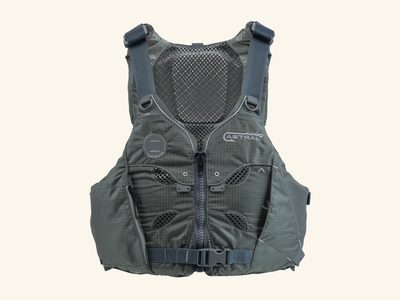
When the complaint is heat, the answer is the V-Eight. Astral's Airescape system, textured foam with vent ports that move air across your torso, is built for hot weather, and the Fisher variant adds fishing pockets. Kayak Angler Magazine named the V-Eight line its best overall fishing PFD for 2026. Owners fishing in 100-degree heat specifically call out the mesh back and airflow. It is USCG Type III with about 16 pounds of flotation in a 1.4-pound vest. Astral V-Eight Fisher is the vest for the angler whose season runs through August in the South.
Two downsides. Storage is thin next to the Chinook and Fisherman: one real pocket setup, not a tackle station. And in the head-to-head Reddit thread where an owner bought both the V-Eight Fisher and the Chinook, the Chinook won on pockets and the plier sheath, and the V-Eight went back. If you need pockets, buy the Chinook.
Mustang M.I.T. 100 ~$130–185
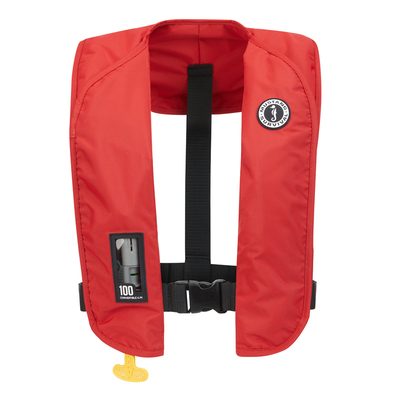
The M.I.T. 100 is the inflatable for the angler who has tried foam and will not wear it. It converts between automatic and manual inflation, so you can run auto on open water and switch to manual when spray or rain might set it off. It delivers 28 pounds of buoyancy inflated, about 1.5 times a foam vest, and Outdoor Gear Lab named it the best auto inflatable of 2026. The one-fold repack is the easiest in the category, and an inspection window shows whether the cartridge is armed. Mustang M.I.T. 100 is the inflatable for the competent swimmer who fishes calm water and wants the vest to disappear until it matters.
The inflatable trade-offs are real and they are the reason this pick is last, not first. Read the next section.
Before you buy an inflatable
Inflatables work, but they come with maintenance and limits that foam vests do not. First, most inflatables are USCG Type V with Type III performance, which means they only count as your legal PFD while you are wearing them. Stowed behind the seat, they count as nothing. Second, they are for competent swimmers 16 and older, on calm water. Not moving water, not cold water where CO2 loses punch, not for anyone who cannot swim. Third, every deployment costs $25 to $35 for a re-arm kit, and until you re-arm it you have no PFD. One flip on a log can end the vest's usefulness for the rest of the trip.
Fourth, the mechanism needs maintenance: check the inflator through the window, replace the CO2 cartridge on schedule (about every 5 years even unused), and test the bladder yearly. A 5-year-old unmaintained auto-inflatable failed halfway in a pool test, choking its owner. A worn inflatable with a missing part contributed to a 2026 drowning on the Columbia River. Fifth, auto-inflate models can fire when you do not want them to: heavy rain, a wet hatch, a humid truck bed. The M.I.T. 100's answer is its manual mode: switch the convertible inflator to manual when rain or spray is likely, and you remove the accidental-deployment risk entirely. But no inflatable is maintenance-free.
None of this means inflatables are bad. It means they are for a specific angler: a strong swimmer, on calm water, who maintains gear and accepts the re-arm cost. If that is not you, buy foam.
What to skip
Cheap no-name inflatables from Amazon. One angler was ticketed because his bargain inflatable was not USCG-approved. If the listing cannot name the approval, it is not a PFD.
Belt-pack inflatables for beginners. They are manual-only, they provide no flotation until you pull the cord, and they offer nothing if you hit your head. Fine for strong swimmers on paddleboards; wrong for a new kayak angler.
Old ski vests and generic big-box vests. The bulky foam collides with kayak seats, rides up, and cooks you by July. One owner found a Walmart vest acceptable in the store and miserable after two hours on the water.
Any vest you will not wear. Fit beats features. A $60 vest worn every trip beats a $180 vest folded behind the seat.
Bottom line
Buy the NRS Chinook if you want the proven all-rounder. Buy the Stohlquist Fisherman if you want the vest owners keep the longest. Buy the Onyx MoveVent Dynamic if the budget is the deciding factor. Buy the Astral V-Eight Fisher if heat is your enemy. Buy the Mustang M.I.T. 100 only if you are a strong swimmer on calm water who will maintain it. Whatever you buy, wear it. The PFD folded behind your seat has never saved anyone.
For setting up the rest of the deck around your vest, see How to Rig a Fishing Kayak for Bass. If you are still choosing the boat itself, see Best Fishing Kayaks for Bass Under $1,000.