A bass you plan to release deserves two things: an accurate measurement and a safe ride back. A measuring board, also called a bump board in the kayak world, gives you the first. It is a rigid ruler with a fence, the raised end the fish's nose presses against, so you get a length without guessing. A lip gripper, the jaw-clamp tool that holds a bass by the lower lip, gives you the second: control of a thrashing fish while hooks come out, without laying it on a hot deck or hanging it by the gills.
The five tools below are the ones that held up across forums, owner reviews, videos, and blogs. Our pick if you buy one board: the Ketch Karbonate, at about $30 to $35. If you fish from a kayak and want a board that floats, the YakAttack LeaderBoard is the one built for the job, at about $60. If the budget is tight, the YakGear Fish Stik folds to a foot long and floats, at about $30 to $40. For grips, the Boga Grip 315 is the buy-once tool, at about $130 to $150. And the kayak grip most owners actually carry is The Fish Grip, at about $15 to $17, because it floats.
How to choose
For boards: legality first, then float. If you fish catch-photo-release (CPR) tournaments, where length on a board decides the winner, your board must be on the trail's approved list. Ketch aluminum is accepted everywhere; the Karbonate is legal on KBF but not all trails (Hobie BOS requires aluminum). The YakAttack LeaderBoard is approved by KBF and a growing list. After legality, the kayak question is float or sink: metal boards sink like a stone, and sunk-board stories are the most common loss reports in the record. Plastic boards like the Fish Stik and the LeaderBoard float.
For grips: rotation matters more than the scale. The feature that separates a good lip gripper from a jaw-breaker is a rotating head. When a bass thrashes and spins, a fixed-jaw grip transfers all that torque to the jaw. A rotating head spins with the fish instead. That is the Boga Grip's signature engineering, and it is the single feature every budget grip lacks. After that: plastic floats and is kinder to mouths, metal is stronger and usually heavier, and anything that does not float needs a lanyard.
Technique beats the tool. The injury pattern owners converge on is not about which grip you buy. It is about how you hold the fish. Hanging a heavy bass vertically by the jaw, swinging sideways out of the water, is the documented way jaws get damaged. Hold the fish horizontal, support the belly with your other hand, or keep it in the water while you work. A grip used right does less damage than dropping a fish on the deck.
The picks
Ketch Karbonate ~$30–35
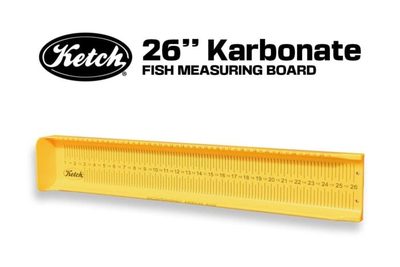
The Ketch is the tournament standard, and the Karbonate is the version most anglers should buy. Its markings are permanent, so they cannot be altered or worn off, which is exactly why trails trust it: the Hawg Trough era ended with bent-board and fat-Sharpie-line cheating scandals. The plastic body is lighter and cheaper than the aluminum Ketch. We found no recurring structural-failure pattern for any Ketch board across multi-season owner threads. No cracks, no warps, no hinge failures.
Two downsides. It sinks, and owners report losing boards overboard. Run a tether through the molded tether hole before it goes on the water. And check your trail before you buy. The Karbonate is legal on KBF trails, but Hobie BOS requires aluminum and some local trails follow suit. Buy a light color: yellow or white boards photograph the tail clearly, while black boards lose tail contrast in CPR photos, and that can cost you a quarter inch with a judge. Ketch Karbonate is the board for the angler who wants the tournament-legal pick without the aluminum price or weight.
YakAttack LeaderBoard ~$60
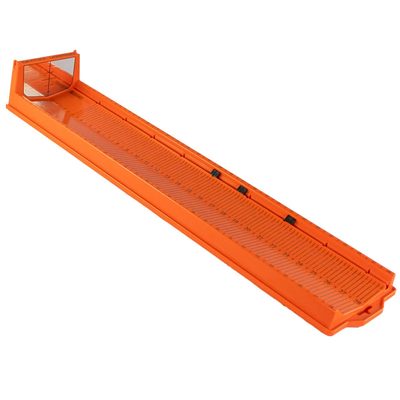
The LeaderBoard was designed from scratch for the kayak tournament angler. It floats upright on foam blocks, which ends the sunk-board problem outright. The 28-inch measuring surface carries quarter-inch increments, and the mirrored fence backing, the reflective strip behind the bump end, helps judges confirm the fish's mouth is closed, which avoids disqualification on close calls. Dual ID holders, sliding cull tabs for tracking your best fish, and individual serialization come in the box. Owners praise the width: thick fish stay on it instead of flopping off the edge. It is approved by KBF and the Kayak Adventure Series.
Two drawbacks. It only comes in 28 inches, and a few owners grumble that is short for the money. The orange-on-black colorway can glare in overhead sun, making the markings harder to read in photos. At about $60 you are paying for the float, the ID holders, and the cull tabs, not for better accuracy. YakAttack LeaderBoard is the board for the kayak angler who wants to stop thinking about tethers and ID-card logistics.
YakGear Fish Stik ~$30–40
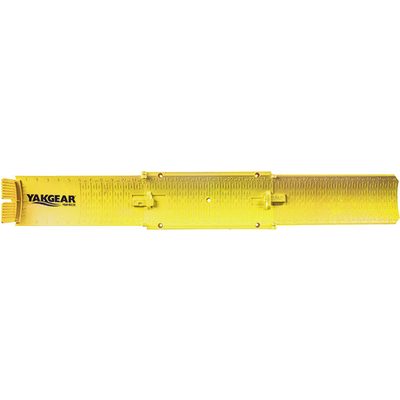
The Fish Stik is the folding floater. Three rigid sections unfold to a 36-inch board and fold down to 12 inches, so it lives under a seat or in a hatch instead of strapped to the deck. It floats. YakGear lists it at $34.99. The long-term record beats the hinge worries: one tournament veteran measured several 20-plus-inch fish, including a personal best near 24 inches, over years of use with no hinge trouble.
Two drawbacks, and they are real. The board ships unmarked: you fill in 500-plus raised markings yourself with the included permanent marker, a job every source describes as tedious. And the locking tabs are the weak point. One owner snapped a tab with a 5-pound bass on an angled board; YakGear replaced the tabs free, and owners praise the service, but the failure happened. It is also not tournament-legal on most national trails, so this is the casual and club angler's board, not the trail angler's. YakGear Fish Stik is the board for the angler who wants a board that disappears into a hatch and floats if it goes overboard.
Boga Grip 315 ~$130–150
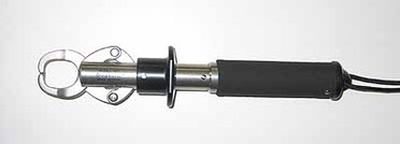
The Boga Grip is the gold standard, and the 315, the 15-pound model, is the bass size. Its signature is the rotating inner tube: the jaws spin 360 degrees, so a thrashing fish twists the tool, not its own jaw. It is the feature missing from nearly every budget grip, and owners name it again and again. The integrated scale reads in quarter-pound increments and can be sent to the IGFA for world-record certification. The body is stainless steel, made in the USA, and the long-term durability record stands alone in this category: a Tackle Warehouse reviewer ran two units for years across bass, pike, musky, and walleye tournaments, with zero rust after multi-season saltwater use.
The catches are the price and the weight. At about $130 to $150 it costs ten of the plastic grips below, and at 9 ounces it is overkill for 1- to 2-pound fish. It sinks, so a lanyard is not optional: a Boga at the bottom of a lake is an expensive lesson, as owners like to say. The spring scale also reads light as the years pass, so zero it before every trip and oil the tool two to four times a year, per long-term owners. Boga Grip 315 is the grip for the angler who wants to buy the tool once and hand it down.
The Fish Grip ~$15–17
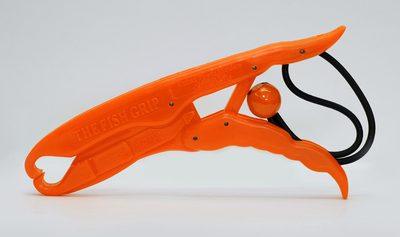
The Fish Grip is the plastic gripper kayak anglers actually carry. It floats. The plastic body cannot rust, and it is built for saltwater. The vise-grip locking jaw clamps with a squeeze and stays locked, so you can tether a fish boatside in the water while you ready the camera or the board. It is made in the USA, in Jackson, Mississippi, and it comes in colors including glow-in-the-dark for night fishing. A Wired2Fish reviewer landed a 22-pound tournament limit with one, canoe-country anglers report multiple solid seasons, and MLF pros use the smaller Jr. model paired with a hanging scale. Salt Strong's take is worth repeating: the wide plastic lip is gentler than thin metal jaws, which can poke a hole through a fish's mouth.
Two downsides. Clamp it on something it was not meant for, a thick limb or a rope, and you can strip the locking mechanism permanently; one multi-year owner stripped his and the grip never locked tight again. And the market is full of knock-off look-alikes, so buy only the original with "The Fish Grip" imprinted on the handle. The Fish Grip is the grip for the kayak or bank angler who wants a floater that costs less than a spool of braid.
What to skip
Knock-off Boga-style grips. They slip out of fish mouths, owners report, and the tall blunt gripping faces do not fit a bass's mouth well. Worst of all, they lack the rotating head, so a spinning fish torques its own jaw. The $15 you save is not worth a dead fish.
Sharp-tipped metal pistol grips for catch-and-release. Multiple owners report the same failure: sharp metal tips puncture the lip or rip through the bottom of the mouth, especially on bigger fish. One owner's verdict after a punctured lip was two words: never again. If you run a metal grip, the tips should be blunt and wide, or the fish pays for the bargain.
The Hawg Trough as a new purchase. The old standard earned its retirement. Owners report breakage under normal use: dropped on grass, leaned on in the kayak. The Sharpie-darkened lines wear off and need redoing. It sinks. And after the bent-board and shortened-board cheating incidents, KBF and Hobie BOS both banned it from their national trails. If you already own one and fish casually, it still measures fish. But nobody should buy one new when the Fish Stik costs about the same, folds, and floats.
Digital-scale budget grips as your only grip. The stainless bodies are fine, but the built-in digital scales draw accuracy complaints, and they run on AAA batteries that die at the worst time. Weigh with a real scale; grip with a real grip.
Also considered
Rapala Floating Fish Gripper 9" (~$14). The rating-count giant: 4.6 to 4.7 stars across more than 3,400 reviews. It floats, it is light and rust-proof, and the one-hand quick release is genuinely fast. It lost the kayak slot to The Fish Grip for two reasons: no rotating head, so thrashing fish torque the jaw, and no locking jaw, so your hand does the holding the whole time. Still a fine buy at the price.
Berkley Big Game Lip Grip 12" (~$50). The stainless step-up for anglers the Boga's price scares off. Longer reach, heavy-duty build, and owners report lipping big fish with it. The owner record is thinner than the Boga's, and it lacks the rotating head, so the angler has to manage the spin.
Bottom line
Buy the Ketch Karbonate if you want the tournament-legal board at a plastic price, and tether it, because it sinks. Buy the YakAttack LeaderBoard if you fish from a kayak and want the board to float, hold your ID, and track your cull. Buy the YakGear Fish Stik if the budget is tight and a board that folds into a hatch beats a perfect board on the deck. Buy the Boga Grip 315 if you want to buy your last lip gripper, and zero the scale before every trip. Buy The Fish Grip if you want a floater for the price of lunch, and buy the imprinted original, not a knock-off. Whatever you buy, hold the fish horizontal and support the belly: the grip is only as gentle as the hands using it.
For keeping fish calm boatside while you measure, see Best Landing Nets for Bass. For setting up the deck around a board and a grip, see How to Rig a Fishing Kayak for Bass.