
A bass lost at the boat stings more than a missed strike. The fish is hooked, tired, and right there, and then it shakes off while you fumble with a net that is too short, too shallow, or tangled in treble hooks. A good landing net fixes the last three feet of the fight, and for catch-and-release fishing it also fixes how the fish goes back: in the water, in a bag that does not strip its slime coat (the slippery coating that protects a fish from infection), with hooks that come out instead of burying deeper.
The four nets below are the ones that held up across forums, owner reviews, videos, and blogs. Our pick if you buy one net: the EGO S2 Slider Compact, at about $130. If you fish from a kayak, the YakAttack Leverage Landing Net is the one built for one-hand netting, at about $100. If the gentlest bag matters most, the Frabill Conservation PLD Net 2612 Telescopic is the boat net, at about $140. And if the budget is tight, the PLUSINNO FN2 Oval Floating Landing Net floats for about $33 to $40.
How to choose
Mesh first. Rubber mesh, a bag made of solid rubber strands, is the kindest to fish and the easiest to free hooks from. Rubber-coated mesh, nylon netting dipped in a rubber coating, is lighter and cheaper and nearly as hook-friendly, but trebles can still find their way into it. Knotted nylon, plain nylon netting tied at every crossing, is the one to avoid for bass: it snags trebles, strips slime, and costs you time at the worst moment.
Hoop size second. A hoop, the frame ring the bag hangs from, around 17 to 20 inches across lands bass without being a sail in the wind. Bigger hoops help on a boat and hurt on a kayak, where every inch is something to stow and snag.
Handle length third, and floats or not fourth. A short handle you can control with one hand beats a long handle you have to wrestle. And a net that sinks is a net you will lose: buy one that floats, or tether the one that does not.
The picks
EGO S2 Slider Compact ~$130
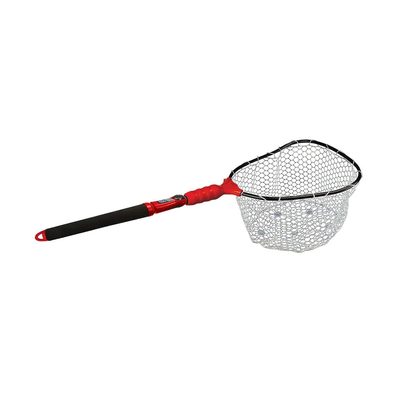
The S2 Slider Compact is our top recommendation for one net for everything. Its handle slides from 18 inches to 36 inches with a push-button release, so it stows short on a kayak or in a rod locker and extends when a fish is at the boat. It floats, which matters more than it sounds: a dropped net on a windy lake is gone in seconds if it sinks. Dick's lists the PVC version at $129.99 and rates it for fish up to 16 pounds. The S2 line is modular, with more than 30 interchangeable heads, handles, and accessories, so a torn bag is a part swap, not a new net.
Two downsides. First, the slider is not a crane: owners warn, repeatedly, never to lift a fish over the side with the handle fully extended, or the handle can break. Scoop the fish, slide the handle back in, then lift. Second, the plastic yoke and slider draw durability questions, and the net is heavier than a cheap folding net. One gap: no owner thread tracked the Slider itself over multiple seasons, so its long-term record rests on the broader S2 line. EGO S2 Slider Compact is the net for the angler who wants one purchase to cover boat, bank, and kayak.
YakAttack Leverage Landing Net ~$100
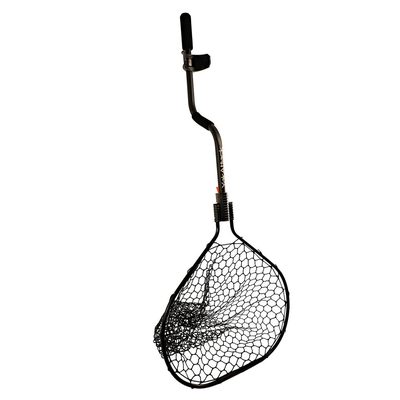
The Leverage is the only net here designed around the kayak problem: one hand holds the rod, the other has to land the fish. Its forearm grip, a cupped rest that sits under your forearm, gives that one hand far more control than a straight handle, and the hoop folds alongside the handle for storage, then flips open with a flick of the wrist. The foam-covered extension stores in a rod holder, which is where most kayak anglers keep it. Tackle Warehouse lists the Leverage line at $99.95, and YakAttack lists the 20-by-21-inch foam-extension model at $100, and the bag is full rubber, the kindest mesh in this guide.
Three downsides, and they are why this net is second instead of first. It does not float, so tether it or accept that a fumble costs you $100. It is heavy, about 3 pounds by one reviewer's scale, and owners call it unwieldy to store and deploy mid-fight. Salt Strong also warns you can pinch your fingers closing it. One more trap: listings attach 12-by-20-inch and 20-by-21-inch hoops and 47-inch and 56-inch lengths to the Leverage name, but those lengths belong to different SKUs, not one model. Check the SKU before you pay: LLN202148 is the 20-by-21-inch base model at 47 inches, LLN202148K adds the foam extension at 54 inches, and the 12-by-20-inch foam model runs 56 inches. YakAttack Leverage Landing Net is the net for the kayak angler who nets fish one-handed and wants the most control per pound.
Frabill Conservation PLD Net 2612 Telescopic ~$140
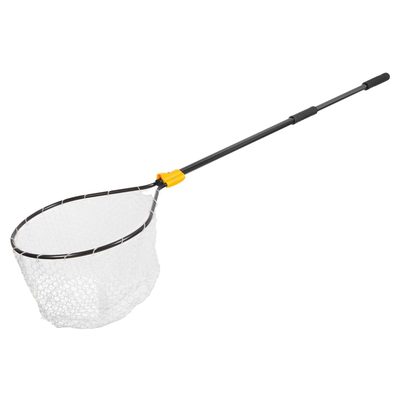
If the release matters as much as the landing, the Conservation series is the bag to buy. The PLD Net 2612 Telescopic has a 23-by-26-inch teardrop hoop and a 22-inch-deep bag. Its telescoping handle runs 35 to 60 inches, and the bag is tangle-free micromesh, a fine knotless mesh that protects the slime coat. The flat bottom, a bag floor that lies level instead of tapering to a point, lets a fish settle instead of rolling, and the MeshGuard hoop leaves fewer places for a lure to catch. Tackle Warehouse lists it at $139.99. Owners of the Conservation family report a decade or more of use, and one month into a 9510, the smaller 20-by-23-inch model, an owner found the clear rubber bag did not strip slime and trebles did not bury, though that is one month of evidence, not a long-term record.
The downside is the lock. Two of the five Tackle Warehouse reviews of this exact model report the telescoping lock failing: one broke within 2 months, the other after little use. The newer Pow'R Loc yoke, the fitting that joins handle to hoop, is meant to be stronger, but that does not settle it, so treat the lock as unproven. Test it hard in the first weeks, buy from a retailer with a plain return policy, and never lift at full extension. It is also heavy on a kayak, and the big hoop catches wind. Frabill Conservation PLD Net 2612 Telescopic is the net for the boat angler who puts the fish's condition first and will check the lock before trusting it.
PLUSINNO FN2 Oval Floating Landing Net ~$33–40
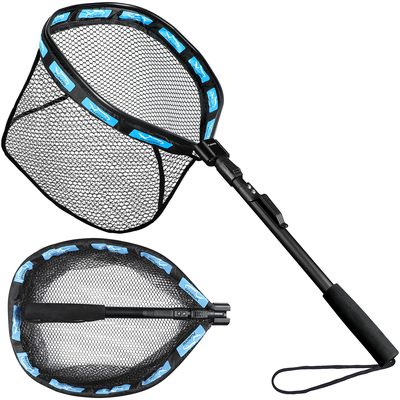
The FN2 is the net that makes a floating net cheap. Foam padding on the hoop keeps it on the surface if it goes overboard, the bag is rubber-coated, the handle folds for storage, and the whole thing weighs 12.5 ounces. PLUSINNO's own store lists three sizes. A fixed 0.8-meter pole costs $32.99 in blue ($39.99 in orange). Telescopic poles run $35.99 to $39.99.
Two downsides. The folding mechanism draws breakage reports, and there are no five-year reports anywhere in the record, so this is a buy-it-and-see net, not a buy-it-for-life net. The hoop and reach are also smaller than the picks above, so it is a poor choice for a big fish at full extension or a boat with high sides. PLUSINNO FN2 Oval Floating Landing Net is the net for the angler who wants a floating net now and would rather replace a $33 net in a few years than lose a $130 one overboard.
Nets on a kayak: the split worth knowing
Many kayak anglers do not use a net at all. Small bass get lipped (grabbed by the lower jaw) or flipped into the boat, and a net is one more thing to stow on a crowded deck. That is a fair position. A net earns its place on a kayak in specific situations: a big fish, a treble-hook lure, a toothy or flappy species, wind that makes lipping risky, or keeping a fish in the water while you unhook it. Several owners who use a net under 10 percent of the time say they would not go without one after losing a personal best at the side of the kayak.
If you carry one, storage is the whole game. Keep it pre-opened on the bow, not folded, because a folding net that must be unfolded mid-fight is a net that costs you the fish. The YakAttack's foam extension fits a rod holder, the EGO's short handle tucks along the gunwale (the top edge of the kayak's side), and anything that does not float gets a tether. For more on setting up the deck around a net, see How to Rig a Fishing Kayak for Bass.
What to skip
Knotted nylon bags. They snag trebles, strip slime, and turn unhooking into a wrestling match.
Shallow rubber "trampoline" bags. They are too shallow to hold a thrashing bass, so fish flop or bounce out before you can secure them.
Oversized boat nets on kayaks. A 36-inch handle and a 25-inch hoop are unmanageable one-handed from a seated position.
Folding nets you must unfold mid-fight. If the net is not open when the fish arrives, it is decoration. Pre-open it or buy one that stores open.
Measuring-strip mesh. KastKing's Pontus puts a measuring scale in the bottom of the bag, and owners report it snags lures and is useless for measuring.
Also considered
Ranger Nets 900 and 910B. The customize-it value pick: owners buy the $35.99 rubberized models, shorten the shaft by about 10 inches, and fill the tubes with foam so they float. The exact rubberized model varies by retailer, so it does not get a card here.
KastKing Pontus. A telescopic net with a built-in measuring scale, but the only detailed owner report is one month old, the net is nose-heavy at full extension, and its knotless nylon still snags a treble. Wait for a longer record.
Frabill Trophy Haul Bearclaw. A one-handed kayak net with a forearm support bar instead of a long handle, plus a lighted module for low light. The owner record is thinner than the YakAttack's.
ForEverlast G2. A floating wading net at about $25 to $30, with owners reporting about two years of use without issues. It is a fine bank and wading net, but its small hoop is not a bass-boat net.
Bottom line
Buy the EGO S2 Slider Compact if you want one net for everything, and never lift with it fully extended. Buy the YakAttack Leverage if you fish from a kayak and net one-handed, and tether it, because it sinks. Buy the Frabill Conservation PLD Net 2612 if the fish's condition is the priority, and test its lock before you trust it. Buy the PLUSINNO FN2 if the budget is tight and a floating net now beats a perfect net later. And whatever you buy, keep it open, keep it close, and scoop before you lift.