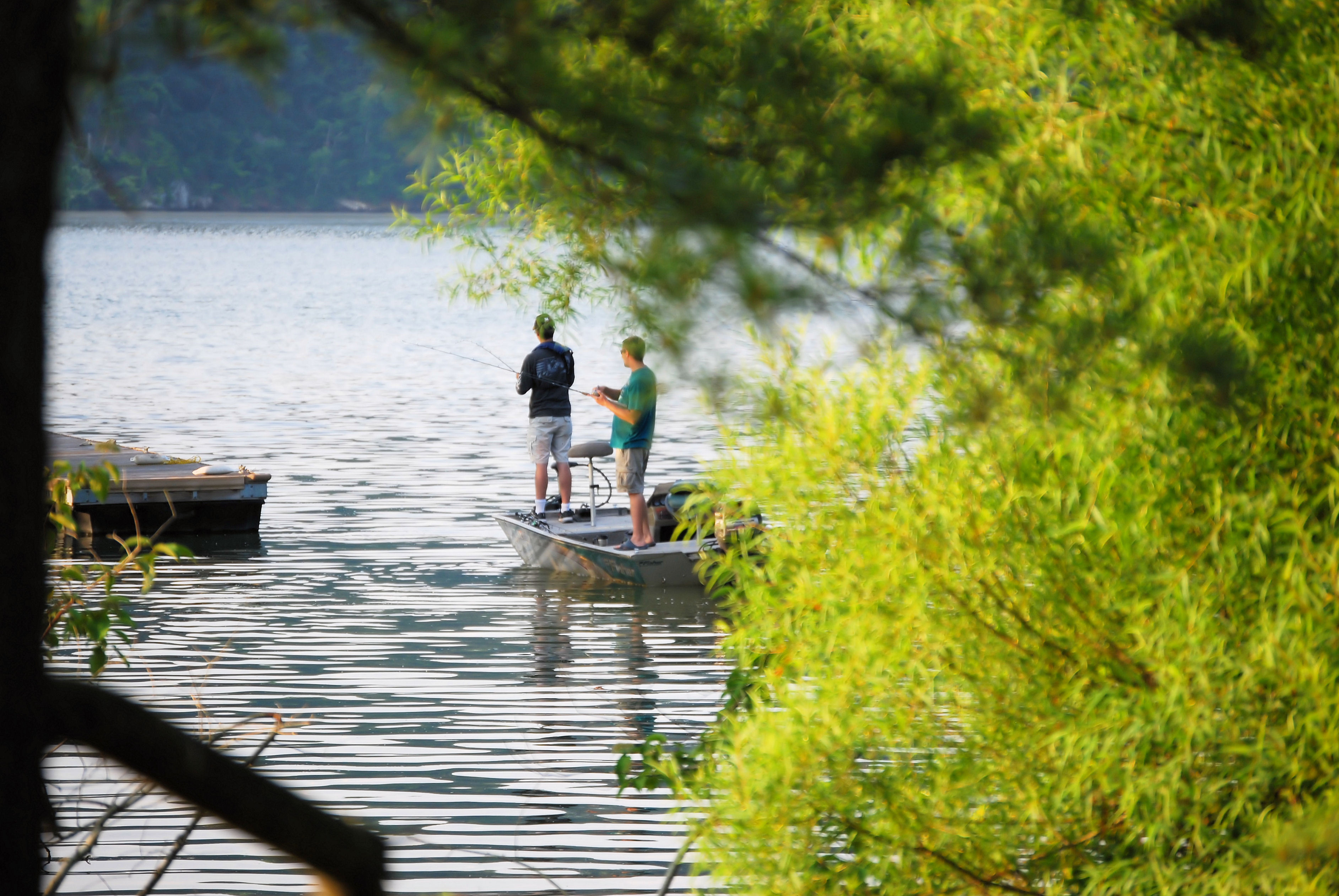
The cover you can see from the ramp
Most lakes have a mile of open water and a few dozen docks and fallen trees, and the bass are not spread evenly across them. They stack up under the wood. A dock gives a bass shade, an ambush point, and a roof over its head. A fallen tree, called a laydown, gives it the same thing with branches in every direction.
The short version: learn to skip a lure under the dock, flip and pitch into the laydown, fish the shady side first, and work every piece of cover from the outside in.
Why bass live under wood
Shade. Bass are ambush feeders, and shade is their cover. On a sunny day the dark water under a dock reads like a weed line, a place to sit unseen while baitfish pass in the light. The hotter the sun, the more the shade matters. Watch the sun angle and the roof pitch, because the shadow often falls well past the dock itself, and the fish sit in the shadow, not under the boards.
Ambush points. A bass wants something to sit behind and something to eat that swims past. A dock post, a cross brace, a pontoon tube, a limb fork: each one is a post a bass can hold behind and dart out from. The fish relate to specific spots, not the whole dock. One corner can hold every fish on it while the rest holds nothing.
Food and depth. Docks collect life. Algae grows on old foam floats, baitfish and bluegill gather around it, and the bass follow. The best dock on a lake is usually the one with deep water a short cast away, so the bass can slide up to feed and drop back down when a boat passes. The same rule holds for laydowns: trees that fell into an old creek channel or down a steep bank, with seven to ten feet of water beside them, fish better than the same tree in two feet of flat water.
Pick the right dock
Not every dock is worth your time, and fishing them all is the slowest way to learn the pattern.
A lone dock beats a row of them. A single dock sitting by itself in the back of a pocket draws every fish in the area to it, because it is the only cover around. A dock on a point works the same way: the fish can move up from deep water to feed and slide back down, all within a few yards.
Old docks fish better than new ones. Weathered wood and old foam floats have had years to collect sunken junk underneath, a dropped chair, a lost bench, a tangle of old rope. All of it holds fish.
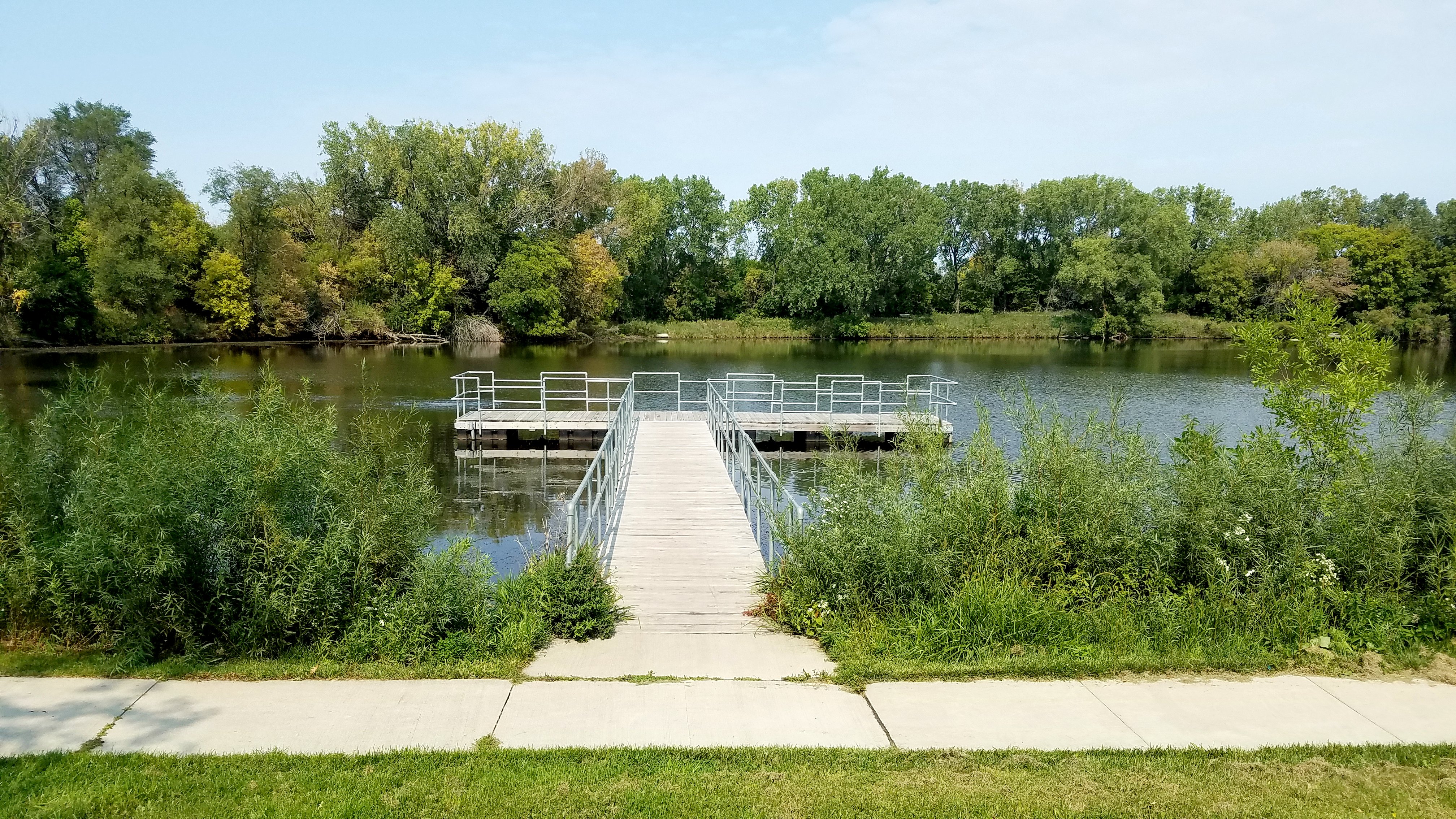
Fixed or floating changes the cast. A fixed dock stands on posts, and the fish relate to those posts and the bottom underneath. A floating dock sits on floats and moves with the water, and the fish often suspend under it instead of hugging the bottom. You cannot really skip a lure under a floating dock the way you can under a fixed one: there are no posts to skip between, and the floats sit low on the water. Cast parallel to it, as close as you can get, drop a bait into an empty slip, or skip into the gap under a pontoon or a walkway.
Skipping: the cast that gets you under
Skipping is the cast that puts a lure under a dock roof. A skipping cast, a low sidearm throw that bounces the lure across the surface like a skipped stone, slides a bait fifteen or twenty feet back under the dock to water no overhead cast can reach. It looks hard. It is learnable in an afternoon of practice.
Keep the rod tip low and the lure close to the water. Let out only ten to fourteen inches of line before the cast: too much line hanging is the number one mistake, because the extra line slaps the water and kills the skip. Make a low sidearm throw, like skipping a rock, and aim the lure at the water three to five feet short of the dock. Stop the rod where you want the bait to go.
Practice on dry land first. Sit in a chair in the driveway and skip a jig across the concrete. That is the drill Gerald Swindle recommends, and it teaches the wrist snap without losing lures. Start at short range and go lower and farther as it clicks.
Baitcaster or spinning is a real split, and both sides have a case. The dock specialists mostly skip on baitcasters, because casting gear handles the hookset and the fight around posts better. The other camp skips on spinning gear because it is easier, it never backlashes, and it works. Start on the setup you already cast well.
Keep it quiet. A jig with exposed lead clanks off a post or a pontoon tube, and the fish hear it. So do the homeowners. Fish weightless plastics, or baits with the weight buried inside the plastic, and nothing hard that pings off the wood. A weightless stick bait, a soft jerkbait, a tube, and a frog all skip quietly.
Fish the fall. Most dock bites come in the first few seconds after the bait lands, or just as it touches bottom. Watch the line. If it straightens early, or you feel a tap when you lift, set the hook right away, because a hooked bass under a dock will wrap you around a cross member in a second.
On jig weight, Gerald Swindle skips a 3/8 ounce jig about ninety percent of the time and says starting heavier is a fight. Andy Montgomery skips a 1/2 ounce jig nearly every time, because it carries enough momentum to go farther with less effort. Start at 3/8 ounce while you learn, and go to 1/2 ounce when you want distance, accuracy, or a faster fall.
Fishing a laydown: outside in
A laydown is a fallen tree lying in the water, trunk, limbs, and root ball, and the biggest mistake is fishing it inside out. Work the outer limbs first, where the active fish are, and move toward the trunk a little at a time. Catch a fish on an outer limb and the bass buried in the trunk never know.
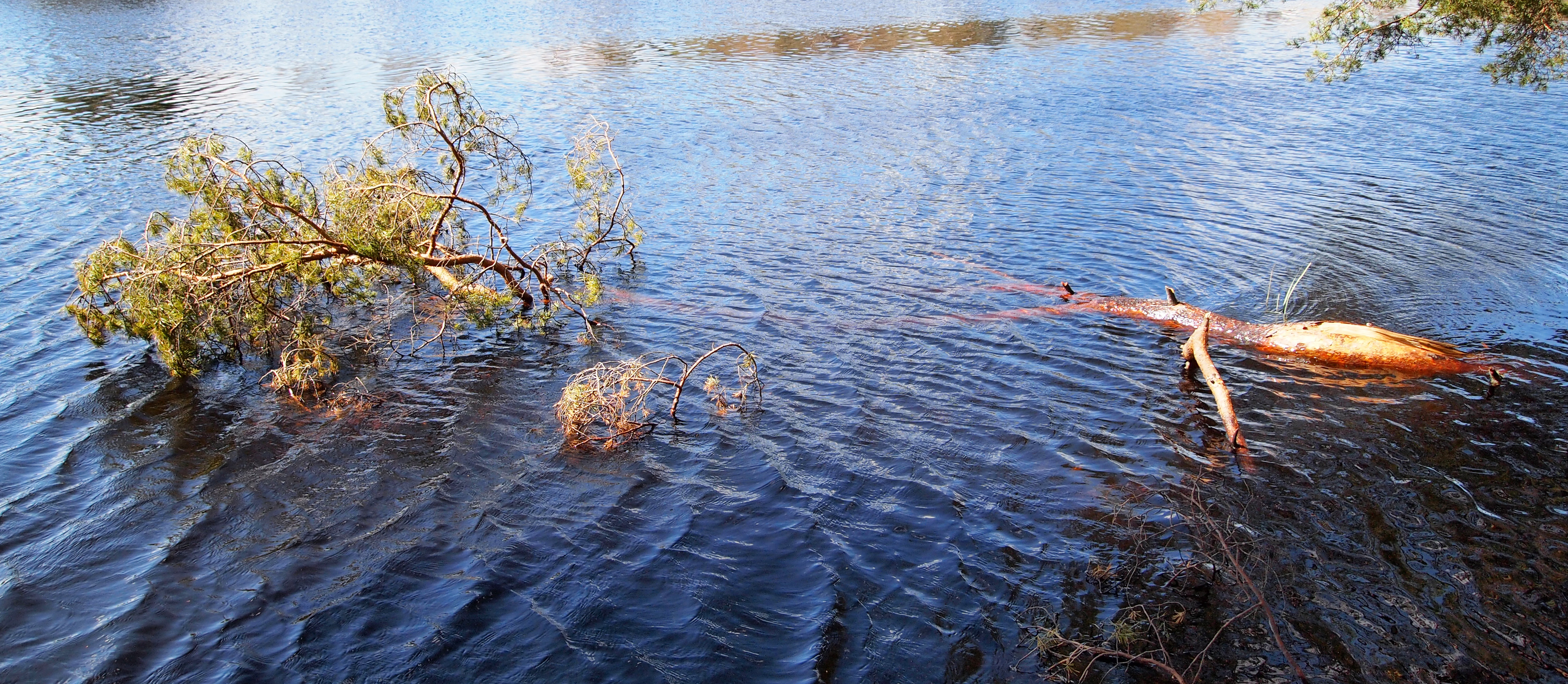
Fish the junctions. A laydown is not one spot, it is a dozen spots. Pitch to each place where a limb meets the trunk, each fork where two limbs cross, and the thick overhead mat where limbs overlap. Then work the main trunk itself, scraping the bait along the wood, and the root ball on the shallow side.
Bump the wood. Bass in a laydown hold tight to the horizontal parts of the tree, the limbs lying flat and the trunk running along the surface. Keep your bait in contact with the wood. Flip a plastic into it, bang a crankbait off it, knock a spinnerbait against it. Contact triggers strikes. Make the first cast along the shady side of the log, not across it.
Flipping and pitching. Two short casts do the work in a laydown, and they are not the same cast. Flipping is the close one: a fixed length of line, about one and a half times the rod length, with the reel engaged, for targets under fifteen feet. Pitching is the longer one: a free-spool pendulum cast, fifteen to fifty feet, quicker to repeat, better in clearer water and sparser cover. Most anglers pitch far more than they flip.
Moving bait first, jig second. Fan-cast the limbs with a spinnerbait first to pick off the chasers. A 1/2 ounce white or chartreuse spinnerbait with a willow blade, slow-rolled through the limbs and allowed to flutter down each time it slides over one, covers a tree fast. Then follow with a jig, 5/16 or 7/16 ounce with a plastic chunk trailer, pitched into every hole and fork.
Edges first or heart first. Here the pros split. Mark Menendez and others work the edges and the perimeter first, then go to the heart of the cover last, so they do not spook fish reaching for other fish. The other school goes straight to the trunk junctions on the first pitch, betting the biggest fish in the tree lives there and the first quiet presentation is the best shot at it. Edges first is the safer play when the spot is easy to spook. Heart first fits when you are sure the biggest fish is dead center.
What to throw
Five baits cover nearly every dock and laydown situation. Our Best Jigs for Bass guide covers the first one in full, and our Best Spinnerbaits and Chatterbaits guide covers the third and fourth.
A jig. The default dock and laydown bait, and the one that catches the biggest fish. A 3/8 or 1/2 ounce Arkie or ball-head jig with a craw trailer skips well, flips clean, and fishes the bottom under a dock or in a tree.
A weightless stick bait. A Senko-style soft stick bait, fished weightless on a Texas rig (the hook threaded weedlessly through the bait with no weight attached) or wacky rigged (the hook through the middle of the bait so both ends wiggle as it sinks). It is one of the easiest baits to skip, lands quiet, and falls slow right where the fish are looking.
A spinnerbait. A 1/2 ounce white or chartreuse spinnerbait with a double willow blade, slow-rolled parallel to a dock or through the limbs of a laydown. Run it along the deep posts, keep it deeper than the floats on a floating dock, and let it flutter down over every limb.
A chatterbait or bladed jig. A vibrating jig, 3/8 to 1/2 ounce, skipped under a dock or swum along the shady side. It is one of the easiest baits to skip, and the vibration pulls fish out of the dark.
A frog or toad. Skipped to the darkest corner under a dock, especially early and late in the day. Frogs are weedless, they skip well, and they imitate the bluegill and shad that spawn around docks. Fish hollow-body frogs on 50 to 65 pound braid: the thick double hooks need a line with no stretch to set, and braid hauls a fish out of the cover. A soft-plastic toad is the exception: 15 to 20 pound monofilament works there, and it will not wedge into the cracks between boards the way braid does.
Line, rod, and the hookset
Line. Fluorocarbon is the skipping line. It sinks, it is nearly invisible, and it springs off wood and metal instead of wrapping around it. Sixteen to twenty pound fluorocarbon covers most dock fishing. Braid has its place: fifty to sixty-five pound braid for flipping into the heaviest cover, where the priority is dragging a fish out of a tree, not finesse.
Rod and reel. A seven to seven foot three inch medium-heavy baitcaster is the standard skipping and flipping rod, with a reel in the 7:1 to 8:1 range to pick up line fast after the hookset. For flipping and pitching, a longer rod, seven foot six, with a moderate action loads deeper on the cast and loses fewer fish than a stiff fast-tip stick.
Set it fast and have an exit plan. A dock bite is a race. The fish is sitting next to a post, a cable, or a cross member, and it knows the way around them better than you do. Set the hook the moment the line moves and get the fish moving toward open water before it turns back into the cover.
Seasons
Spring. Before the spawn, fish the laydowns next to shallow bays and the first point into a cove, with seven to ten feet of water beside the tree. As the water reaches the mid sixties, bass move onto laydowns in two to five feet of water on flats and side pockets to spawn.
Summer. This is dock season. The fish slide to the deep, shady end of the dock, and the midday bite belongs to the pontoons: big, low to the water, throwing a wide patch of shade. On laydowns, fish the shaded side and the deepest limbs, and downsize to a shaky head or a wacky worm when the fish get picky.
Fall and winter. In fall the bass spread out and feed hard before winter, orienting to baitfish. Fish moving baits between the docks, a squarebill or a buzzbait or a vibrating jig, and slow down only for the docks themselves. In winter the fish go deep and slow down, so fish the docks on or near channel swings with a slow jig, and skip the shallow laydowns until spring.
Mistakes that empty a dock
Fishing inside out. Go for the trunk or the heart first and you spook every fish in the cover. Work the outside in, closest fish first, and save the heart for last.
Clanking lead off the posts. Exposed lead or a hard bait pinging off a pontoon spooks the fish and angers the homeowner. Fish quiet plastics until you know the spot.
Rushing past the good ones. The anglers who catch the most dock fish make a few casts to hundreds of docks, not fifteen minutes on each one. Pattern the productive corner and repeat that exact cast dock to dock.
A word on etiquette
Docks are someone's property, even when the water is public. Be courteous. Do not cast over boats, do not bump the dock with the trolling motor, and do not leave a lure hanging in a rope or a cable.
The bottom line
Docks and laydowns are the most fishable cover on most lakes, and the method is simple enough to state in one line: skip or flip a jig to the shade, work the cover from the outside in, and set the hook the moment the line moves. The cast takes an afternoon to learn. The reading, which dock, which corner, which limb, takes a season. Fish a few casts to a lot of docks, pay attention to where the bites come from, and run that pattern until the lake tells you a new one.