Your jig box is probably lying to you. Most anglers own jigs they can't name the job for: a football head they pitch into bushes, a flipping jig they drag across gravel, three weights of the same bait that all fish the same spot.
Jigs aren't one tool. They're three, and the head shape decides which job each one does. A flipping head slides into heavy cover. A football head drags across rock without wedging in. A finesse head gets bit when the water is cold and clear and the bass have seen everything.
We read roughly 240 real angler reports across Reddit, BassResource, UltimateBass, retailer reviews, YouTube breakdowns, and tackle blogs to find the four jigs that survive their critics. Jigs are the most brand-loyal category we've covered, and the anglers are right about the hooks, not the hype. Across every source, the number one differentiator was hook quality, then wire-tied versus rubber-band skirts. Paint and price came last.
The quick answer
Start with a Dirty Jigs Tour Level Pitchin' Jig in 1/2 oz. It's the one name that showed up in nearly every source we read, from beginner threads to TacticalBassin's "if you could only have one" video. Add a Strike King Hack Attack for the nasty cover you actually want to punch into, a Keitech tungsten football for rock, and a Strike King Bitsy Bug for finesse days. Four jigs, about $25 total, every situation covered.
| Pick | For | Price band |
|---|---|---|
| Dirty Jigs Tour Level Pitchin' Jig, 1/2 oz | Do-everything flipping and pitching | ~$6 |
| Strike King Hack Attack Heavy Cover Flipping Jig, 1/2 oz | Heavy cover on braid | ~$7 |
| Keitech Model II Tungsten Football Jig (Version 2), 3/8 oz | Dragging rock, smallmouth | ~$8 |
| Strike King Bitsy Bug Jig, 1/4 oz | Finesse, ponds, pressured fish | ~$3.50 |
The picks
Dirty Jigs Tour Level Pitchin' Jig ~$6
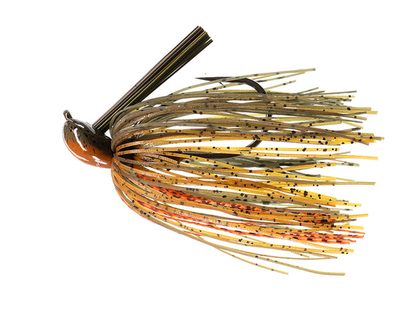
Dirty Jigs Tour Level Pitchin' Jig, the arkie head every source recommends — link goes live soon
The convergence here is the strongest we've seen in a jig guide. TacticalBassin calls the 1/2 oz "The Go To" his if-he-could-only-have-one jig. Field & Stream named it their flipping/pitching pick. It's a Tackle Warehouse Best Seller, and Bass Forecast recommends it for fall flipping. Reddit's brand thread landed on "can't go wrong," and forum regulars keep buying them for one reason: the components are heavy-duty and the arkie head comes through wood and docks instead of hanging up.
The specs are simple: traditional arkie head, 5/0 Mustad hook, a semi-recessed line tie that makes it a touch more weedless than a standard arkie, in 3/8 or 1/2 oz. Buy the 1/2. It pitches, casts, skips under docks, and flips into laydowns, the one jig shape that does everything short of deep rock work.
Two real knocks from long-term owners: the skirts are rubber-collared, not hand-tied, and several owners report newer batches stick together and don't flare like the old ones. And the paint wears off the head fast on rock. Buy it for the components and the head shape, not the finish. Check the hook point before it goes in the box. A few forum veterans file every new jig anyway.
Not for: matted grass. An arkie head is the wrong shape for punching mats. That's a different tool, and most beginners do it better with a Texas rig anyway.
Strike King Hack Attack Heavy Cover Flipping Jig ~$7
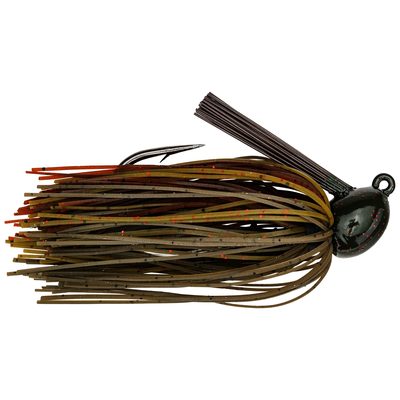
Strike King Hack Attack Heavy Cover Flipping Jig, Greg Hackney's heavy-cover hammer — link goes live soon
When the cover gets serious, the mass-market flipping standard is Greg Hackney's Hack Attack. Wired2Fish's Jason Sealock fished it through a full day of hooksets and found the hook still sharp, the 30-degree line tie keeling the jig upright through grass, and a 4-lb bass boat-flipped with no hook flex. The selling point is the heavy-wire Gamakatsu hook. Reviewers on multiple retailers converge on one theme: this hook does not bend, including one memorable report of a hookup so strong the angler had to cut the line.
Fish it on a heavy flipping stick with braid or heavy fluorocarbon, the way it's built to be fished. The fluorocarbon-specific sibling version draws the only consistent complaints in the line, with a skirt several reviewers call too sparse. And the Hack Attack's weed guard runs thick out of the package. Trim it to just past the hook point and your hookup rate goes up.
Not for finesse water or light tackle. This jig on a spinning rod is like towing a boat with a sedan, and clear, pressured lakes call for the Bitsy Bug below.
Keitech Model II Tungsten Football Jig (Version 2) ~$8
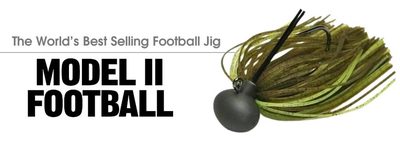
Keitech Model II Tungsten Football Jig (Version 2), the sensitive smallmouth specialist — link goes live soon
The football pick is a recommend-with-conditions. Everyone agrees on what the Keitech does: the tungsten head is 30% smaller and harder than lead, so you feel every pebble on the retrieve. The skirt is hand-tied 100-strand silicone, the weed guard is hand-glued, and the hook is a custom Gamakatsu 2/0. Smallmouth anglers are its loudest fans. One reported catching 90% of his big smallmouth on it, working rocky points in cold water with swim, bounce, and deadstick presentations. TacticalBassin reaches for it in two different videos.
The knocks converge just as strongly: about a third of long-term reviewers call it overpriced at $8 a jig. The hook is light wire, and multiple owners report bend-outs on heavy hooksets, one snapping on a one-pound largemouth. Fish it on a medium-heavy rod with 12 to 15 lb fluorocarbon and let the rod do the work. In pike country or timber, where snags are a certainty, an $8 tungsten jig is a tax you pay every trip.
Not for: thick cover. A football head in vegetation is, in one Reddit thread's words, a "hangup nightmare." The head shape deflects off rock and wedges in grass. That's physics, not a flaw. For dragging rock on a budget, the Dobyns football jig (about $10 for three, Gamakatsu hooks, hand-tied skirts) is the value answer.
Strike King Bitsy Bug Jig ~$3.50
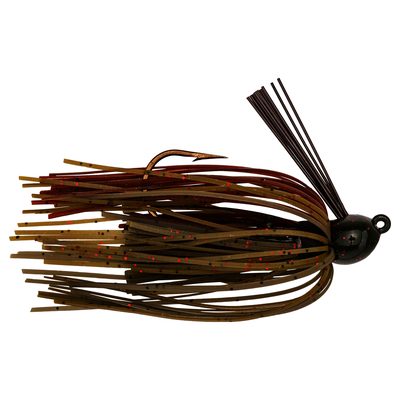
Strike King Bitsy Bug Jig, the finesse jig that costs less than a coffee — link goes live soon
This is the convergent value pick of the entire corpus. Tackle Warehouse gives it 4.4 stars across 11 reviews. Reddit's jig threads name the Bitsy line repeatedly, especially for smallmouth, where pairing it with a Keitech swimbait or Zoom Speed Craw is a local legend in some waters. The theme: it gets bites when nothing else does, and it's cheap enough to throw into the gnarliest dock pilings without a second thought.
The price explains the compromises. The skirt is rubber-collared and slips off the head after a day or two of fishing. The trailer keeper is weak, so trailers slide down the shank. The light-wire hook can bend on a big fish, and forum voices confirm this on the Bug specifically. That's the whole reason Strike King makes the Bitsy Flip (about $4, heavier hook, thicker weed guard, 5.0 stars, one reviewer calling it a top-10 all-time jig). If you're flipping around cover where a five-pounder lives, buy the Flip instead. For open-water finesse on spinning gear, the Bug is the right tool at the right price.
Not for: heavy-cover extraction. A $3.50 jig with a light hook has no business in matted grass.
What weight to start with
The forums and one 89-comment Reddit thread repeat the same rule: 1/4 oz for finesse and cold water, 1/2 oz as the do-everything middle, 3/4 to 1 oz for punching cover or staying on the bottom in wind. Match the weight to the cover and depth, not the fish. A 1/2 oz jig on a calm pond falls like an anvil; a 1/4 oz jig in 20 feet of wind never reaches bottom.
What to skip
A dedicated punching jig as your first heavy-cover tool. One well-argued thread called punch jigs flat-out useless for most anglers: a Texas rig with a heavy bullet weight punches the same mats, costs less, and hangs up less. The specialists will disagree, but until you're fishing mats weekly, the Texas rig covers it.
The 6th Sense Divine Hybrid Jig. Milliken Fishing ranked it in his top five, but Omnia lists it as discontinued and we couldn't verify current availability. A pick you can't buy is a dead link. If 6th Sense brings it back, it re-enters the conversation.
Tungsten as a learning jig. The Keitech above is a superb tool, but beginners lose jigs. Learn on the Bitsy Bug at $3.50, then spend $8 a jig when you know where the snags are. The reverse order is an expensive education.
Buying all four weights of the same jig. The most common waste we saw: beginners owning four sizes of one head shape. One head shape, one right weight, fished in the right cover, outfishes a box of mismatched tackle every time.